

- Game Development
- >
- AR VR Game Development
AR VR Game Development Company
Trusted By
Brands, Studios And Businesses Worldwide










What We Build
AR VR Game Development
Across Devices & Interactions
Our AR & VR game development company builds around your target hardware from day one. Spatial interaction and gameplay systems come first, with multiplayer, optimization, testing, and platform-ready delivery planned around the way the game will actually be played.

Platforms
- Meta Quest
- PS VR2
- PC VR
- iOS
- Android

Prototype & Validation
- Interaction Prototype
- Hardware Testing
Engines & Technologies
- Unity
- Unreal Engine
- OpenXR
- ARKit
- ARCore


Full Production
- Gameplay
- Art
- Multiplayer
- QA
Experience Types
- VR Games
- Mobile AR Games
- Location-Based AR
- Multiplayer VR
- Room-Scale VR
- Social Experiences

Delivery Focus

Frame-Rate Targets
Performance optimization

VR Comfort
Locomotion and interaction

Tracking Validation
Spatial and controller testing
DELIVERY
AR VR Game Production
Built Around the Hardware
AR VR game development outsourcing works best when gameplay, art, interaction, and performance are not planned in isolation. They need to move together from prototype through production.
Our AR & VR game development company can support complete AR VR productions or defined workstreams within an existing game project.
Established
in 2011
Red Apple Technologies has supported game development since 2011, bringing engineering, art, design, testing, and production support together for interactive projects.
One Team,
Shared Workflow
Gameplay engineering, 3D art, interaction design, multiplayer, and QA follow shared milestones, keeping technical and production decisions aligned.
Target-Device
Validation
We test key interactions on target hardware early to evaluate tracking, controls, comfort, performance, and device constraints before deeper production begins.
Full Builds or
Defined Scope
Engage us for complete AR VR game production or focused workstreams such as prototyping, gameplay systems, art, porting, optimization, testing, or ongoing support.
AR VR Services Across the Production Cycle
Some projects begin with an idea. Others come with a prototype, existing build, or a specific technical gap
Our AR VR game development company can cover the full production cycle or selected workstreams based on your scope, hardware, and release goals.
Full-Cycle AR Game Development
Build mobile and location-based AR games from concept and prototyping through development, testing, and release.
Full-Cycle VR Game Developmen
Develop VR games around target headsets, interaction systems, gameplay, 3D content, testing, and launch requirements.
AR VR Prototyping and Pre-Production
Validate gameplay, controls, spatial interactions, hardware fit, and technical feasibility before deeper production begins.
Multiplayer and Backend Development
Build real-time multiplayer, matchmaking, player data, progression, and backend systems for connected AR VR games.
AR VR Porting and Optimization
Adapt existing games for new devices or platforms while tuning controls, rendering, memory, and target-device performance.
Ongoing Development and Support
Support updates, new content, compatibility changes, optimization, testing, and post-launch development after release.
Explore Our Broader Game Development Capabilities
From mobile and console to multiplayer, porting, testing, and ongoing support, explore the broader game development capabilities available across your production lifecycle.
View Game Development ServicesFROM OUR PORTFOLIO
AR VR Games Built Across Platforms
Explore selected AR & VR game projects where our teams contributed to development, art, gameplay systems, multiplayer, optimization, testing, or ongoing production.


BEFORE YOU BUILD
Four AR VR Questions
to Settle Before Production
AR VR projects add hardware, interaction, performance, and comfort constraints to normal game production. Our AR VR game development company can identify those risks early so scope and technical decisions stay grounded.
Will It Run Well on the Target Hardware?
We define target devices early and test around their real limits. We look at rendering load, memory, tracking, controls, and thermal constraints during prototyping, not as a late-stage fix.
Will the VR Experience Feel Comfortable?
Comfort depends on more than frame rate. We review locomotion, camera behavior, interaction distance, movement speed, and input design together so we can tune the experience around your audience and hardware.
What If Platform Requirements Change?
AR and VR ecosystems evolve quickly. We keep platform-specific dependencies visible and separate where practical, making it easier to respond to SDK, device, store, or operating-system changes during production and after launch.
Can We Build on What Already Exists?
Yes, where the existing project allows it. We first review the prototype, codebase, assets, engine version, integrations, and target devices to determine what can stay, what needs rework, and where rebuilding is the safer option.
FLEXIBLE ENGAGEMENT
Three Ways to Start Your
AR VR Game Project
Choose the model that fits your current stage, internal team, and level of production ownership needed.
01
You Need End-to-End Ownership
Full-Cycle
AR VR Production
Best suited when you have a concept, requirements, or early prototype and need one team to manage production. We can cover gameplay, 3D art, spatial interaction, backend, testing, optimization, and release preparation around agreed milestones.
Discuss Full-Cycle Production02
You Already Have a Team
AR VR
Co-Development
Bring us into an existing production for defined workstreams such as gameplay systems, interaction design, art, multiplayer, porting, optimization, or QA. Responsibilities and handoffs stay clear within your current production workflow.
Discuss Co-Development03
You Need to Validate First
Prototype &
Validation Sprint
Start by testing the core gameplay, spatial interactions, target hardware, controls, and technical feasibility before committing to deeper production. The sprint helps identify what works, what needs iteration, and what the larger build may require.
Start With a PrototypeBUDGET & TIMELINE
How Much Does AR VR Game
Development Cost, and How Long Does It Take?
These are indicative planning ranges, not fixed quotes. Target hardware, interaction complexity, 3D content, multiplayer, and platform coverage can affect both cost and timeline.
AR Prototype
$15K-30K
Indicative Cost
6 - 10 Weeks
Typical Timeline
Mobile AR Game
$25K-60K
Indicative Cost
3 - 6 months
Typical Timeline
Standalone VR Game
$40K-100K
Indicative Cost
4 - 8 months
Typical Timeline
Multiplayer / Multi-Platform
$100K-300K
Indicative Cost
8 - 14 months
Typical Timeline
Complex AR VR Production
$180K-500K
Indicative Cost
12 - 24+ months
Typical Timeline
AR VR FIELD NOTES
What Shapes an AR or VR Game?
From spatial interaction and VR comfort to headset constraints, engine choices, porting, and performance, explore the decisions that influence how AR and VR games are designed, built, and released.
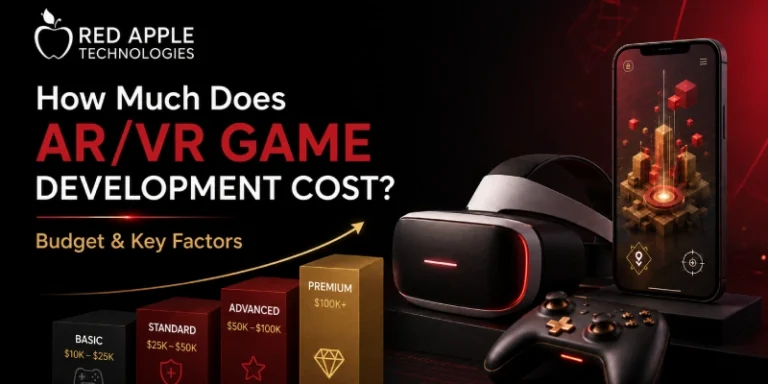
AR/VR Game Development Cost: Budget & Key Factors
An AR prototype built around one core interaction and a multiplayer VR game designed for several headsets should not receive anything close to the same estimate. Both may fall under…
Best VR/AR Game Studios in the United States
The United States continues to lead global immersive technology innovation. With strong hardware ecosystems, venture capital investment, and enterprise adoption accelerating across industries, AR VR game development in the USA…
Which are the Top 10 AR & VR Game Development Companies in 2026?
Initially, gamers never had the chance to interact or engage with game characters, environments, or objects deeply within the real and virtual worlds. But! With the introduction of Augmented Reality…
Questions Before You Start an AR VR Game Project
Yes. Red Apple Technologies can sign your NDA or provide one before you share confidential project details such as your game concept, prototype, source code, assets, technical documentation, or product roadmap. Confidentiality requirements can also be reflected in the project agreement and access process once development begins.
Ownership is defined in the project agreement before production begins. For projects where you own the IP, agreed deliverables can include source code, project files, game assets, documentation, and other IP created specifically for the engagement. Third-party tools, licensed assets, SDKs, and middleware remain subject to their respective license terms.
Yes, release preparation and submission support can be included within the agreed scope. Depending on the platform, this may involve build preparation, technical checks, device testing, store requirements, submission support, and issue resolution. We plan the exact process around the intended hardware and distribution channels.
We can start with whatever you already have: a concept brief, GDD, prototype, existing build, references, or technical requirements. The most useful inputs are your intended gameplay, target devices, platforms, multiplayer needs, art direction, existing assets or code, production scope, and release priorities. If some of these are still open, a discovery or prototype phase can help define them.
We choose the technology stack around the game rather than defaulting to one engine or framework. Target hardware, the existing codebase, rendering requirements, interaction model, platform coverage, performance limits, and maintenance needs all matter. Unity or Unreal Engine may support the core production, while ARKit, ARCore, or OpenXR can address platform-specific AR and VR requirements where appropriate.
It depends on the product strategy and technical scope. Starting with one primary platform can simplify early validation of gameplay, interaction, performance, and player response before expansion. Multi-platform development may make sense when wider device coverage is required at launch, but hardware differences, SDKs, controls, performance limits, submission requirements, and platform-specific constraints need to be planned early.
Start with the experience the game needs to create. AR is well suited to gameplay that interacts with the player's real environment, while VR is better suited to experiences built around full spatial immersion and headset-based interaction. Audience, target hardware, session design, distribution strategy, gameplay mechanics, and production budget should guide the decision.
Tell Us Where Your
AR/VR Game Stands
Get a reply within 24 hours
Tell us where the project stands today. We'll start there.


 Book An Appointment
 WhatsApp