


Once in a while, a topic comes our way that we feel needs its every aspect touched. Yes, this is one of them. So, hang tight — the answer won’t come easy (unless, of course, you already knew it).
Game publishers—their logos appear in game trailers and splash screens, and players remember them when they play another game by the same publisher. For example, Supercell is a big name in the global mobile gaming community; Clash of Clans, Boom Beach, and Hay Day took smartphone gaming by storm. So the hype behind its latest release Mo.co was expected and natural. This is branding, and it’s effective. But who are game publishers? Are they the money behind the title or the ones responsible for marketing?
The easy answer: they are a fusion of everything, from being part of the development and finishing processes of the game to its promotion, launch, and post-launch lookout. The bigger picture: they are the companies behind making games and communicating them to players.
A game publisher works with game developers to build the game and handle things beyond game development. They are involved in funding, promoting, planning the game launch, and usually distributing too. So, if you make a game with us at Red Apple Technologies, you will be the game publisher, and we will be the developer.
Now let us get to the heart of the topic—
Why Cheap Games Deliver Big Profits
Hyper-casual gaming has reshaped the landscape of gaming on handheld devices, creating a lucrative space where publishers achieve impressive returns by leveraging low development costs and high-volume distribution. Let’s explore the economic foundation, operational strategies, emerging trends, and the unique role played by Red Apple Technologies in helping studios thrive in this dynamic sector.
This game genre is founded on the principle of simplicity, like single-tap mechanics, bright visuals, and accessible gameplay that appeals to broad audiences across demographics. It’s deceptively straightforward: games that can be finished in minutes and understood in seconds. Yet, beneath this simplicity lies a complex economic system where operational mastery, portfolio strategy, and rapid experimentation drive profit.
The Economics of Hyper-Casual Gaming
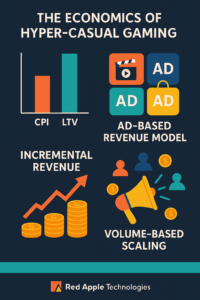
The primary revenue engine for hyper-casual games is in-app advertising (rewarded videos, interstitials, banners, and playables), delivering cash flow based on the sheer number of impressions rather than the depth of player engagement. The adoption of hybrid models, which mix ad streams with light in-app purchases or meta progression, has allowed publishers to complement ad-based income with incremental revenue from higher engaged player segments. Most studios recognize that single titles rarely recoup acquisition costs through ads alone; instead, the winning strategy is a volume-based approach supported by prototyping, cross-promotion, and continual creative testing.
Unit economics are simple yet crucial. Publishers must maintain a cost per install (CPI) below the player’s lifetime value (LTV), with average revenue per daily active user (ARPDAU) driven largely by ad yield and user retention. Creative iterations (test videos and playables) can rapidly cut CPI, while advanced mediation and segmentation boost ARPDAU. Cross-promotion among live titles creates efficiencies, lowering reacquisition costs and spreading risk in a volatile market.
Mobile Games’ Scalability and Reach
Mobile gaming is a fertile ground for hyper-casual genres. With more than 3.5 billion downloads of hyper-casual games in 2024 alone, publishers have a vast, underserved audience to monetize. The genre’s appeal owes much to accessibility: rapid download, minimal device space usage, and the promise of instant enjoyment. Short play sessions, often under 15 minutes, ensure games fit seamlessly into daily routines.
The broad demographic reach is equally compelling. Women now represent the largest gamers segment globally in hyper-casual games, accounting for 55 to 60 percent of players in major markets. This diverse and growing audience attracts advertisers, further reinforcing the economies of scale fundamental to hyper-casual success.
Operations Mastery: Prototyping and Portfolio Strategy
Behind every hit lies dozens of prototypes tested with real users. Studios push out rapid iterations, analyzing retention and ARPDAU to select winners for scaling. Operational excellence means not just producing games quickly but managing marketing spend, creative output, analytics, and live operations. Ad mediation platforms, programmatic UA, and live-ops infrastructure are vital in maximizing returns.
A publisher’s portfolio offers robust advantages; multiple live titles enable cross-promotion, creative cost amortization, and faster scaling of proven mechanics. This approach mitigates volatility, securing steadier returns versus risking everything on single titles.
Risks and Market Dynamics
The apparent simplicity of hyper-casual games belies ongoing challenges. Rising CPI in crowded markets can undermine profitability, while platform policy changes or privacy regulations affect ad tracking and UA efficiency. Revenue concentration around hit titles means most games will be financial failures without smart prototyping, data-driven decision-making, and portfolio synergy.
Teams must remain agile and diversify: experimenting with game mechanics, exploring new geographies, and hybridizing monetization strategies all help cushion external shocks. Studios that run disciplined hypothesis cycles (testing, learning, iterating) outperform those relying solely on luck.
Hyper-Casual Mobile Game Development by Red Apple Technologies
We stand out in the world of mobile game development services for hyper-casual projects. With vast experience across Unity, Unreal, HTML5, and more, Red Apple Technologies deliver value from concept through to launch and live-ops.
End-to-End Partnership: Our services span design, prototyping, creative production, ad monetization setup, and cross-promotion systems, offering strategic depth and creative velocity to publishers.
Agile Delivery: Our workflow is defined by rapid hypothesis and test cycles, enabling faster market validation and cost-effective scaling of successful mechanics.
Hybrid Monetization Expertise: With us, studios layer light meta progression and in-app purchase options atop core hyper-casual loops, lifting LTV without diluting viral appeal.
Yield Optimization: Their ad-ops specialists optimize mediation, run segmented eCPM experiments, and monitor yield by geography, ensuring studios maximize ad revenues.
Flexible Staffing: Publishers can hire game developers or entire teams using our flexible engagement models, enjoying specialized skills and responsive support.
24/7 Support: Beyond delivery, we maintain games with round-the-clock troubleshooting, updates, and performance monitoring, which are crucial for sustained success in mobile game development.
Rising Trends in Hyper-Casual Games
New trends are emerging as competition intensifies. The rise of hybrid casuals combines the simplicity of hyper-casual games with the depth of mid-core features, driving better retention and revenue in a segment once seen as wholly shallow. Immersive narratives, once rare in the genre, are now being gradually added to hook player curiosity and encourage repeat sessions.
User-generated content and personalization fueled by Web3 and AI are transforming player engagement. Gamers expect tailored experiences, and studios are using generative AI to deliver customized environments, characters, and rewards that boost long-term loyalty. We integrate next-generation tech stacks to help studios leverage these trends for competitive advantage.
How We Help Publishers Win Big
Red Apple Technologies delivers strategic solutions specially tailored for publishers:
- Prototyping at Scale: Teams build and test multiple prototypes using leading engines, fast-tracking market discovery, and maximizing creative output.
- Dedicated Hiring: Businesses can hire game developers with specific expertise in hyper-casual design and monetization, utilizing flexible models from dedicated teams to project-based contracts.
- Portfolio Expansion: We help firms scale their catalogues quickly, efficiently, and cost-effectively, ensuring steady growth in turbulent markets.
- Hybrid Monetization and User Growth: Studios are guided in the integration of hybrid systems, with ongoing support for UA and marketing campaigns tailored to maximize LTV and minimize risk.
- Continuous Support: Offering 24.7 troubleshooting, code modification, and version updates to ensure uninterrupted service and robust game performance.
Our experience, technical prowess, and strategic vision make us a trusted partner for publishers looking to unlock the full potential of hyper-casual gaming.
The Future: Continuous Evolution
The hyper-casual genre will continue to evolve gradually. Creative and playable ad formats will lead the charge in UA innovations; hybrid monetization will become standard for studios seeking healthier margins; and broad portfolio strategy will remain the best defense against rising acquisition costs and ad market volatility. Studios that pair fast experimentation with disciplined economics and collaborate with mobile game development services experts for creative and operational gaps are best-positioned for enduring success.
To Have A Better Understanding On This Let us Answer The Following Questions
Answer: Healthy early prototypes typically target a payback period (recoup user acquisition costs via ad revenue) of under 7 days, a critical benchmark for most publishers. More broadly, some industry cases see payback periods ranging from several months to a year when scaling or operating in highly competitive/ad-saturated markets. Fast payback is essential due to high churn rates and market volatility; studios often test creative performance and retention rigorously to ensure quick returns.
Answer: Publishers rely on rapid prototyping and analytics, pushing out many concepts and only scaling titles with strong early numbers on retention and monetization. Diversification is key: managing a wide portfolio allows for cross-promotion and spreading risk; successful games help offset those that underperform. Utilizing operational rigor and disciplined user acquisition (UA) strategies, publishers keep costs predictable while maximizing the chances of finding viral hits.
Answer: Rewarded video ads generally provide the highest eCPMs and drive strong engagement by incentivizing players to watch ads in exchange for in-game rewards. Playable ads help attract quality users and improve acquisition metrics, while interstitials offer frequent ad touchpoints and steady revenue. Banners supply a lower, but reliable, income floor; publishers often fine-tune ad mixes per geography and user segment for optimal results.
Answer: Emerging markets are increasing global install volumes and ad impressions, often at lower CPI, which boosts aggregate revenue while diversifying audience profiles. Growth in these regions encourages publishers to optimize ad mediation for local demand and experiment with hybrid monetization, sometimes blending ad streams with targeted in-app purchases for improved LTV. As device penetration rises and player habits change, adapting monetization to reflect local preferences and payment methods will be vital for growth.
Answer: We offer end-to-end support for post-launch phases, including ad mediation configuration, creative asset refresh, live A/B testing, and ongoing analytics to optimize eCPM and retention. Their team manages user acquisition campaigns, segmenting for geography and audience type to maximize ROAS while providing 24.7 technical support, troubleshooting, and performance updates to ensure live games remain competitive in a fast-evolving market.





 Book an Appointment
 Get Instant Project Estimation
 WhatsApp Now
 Select Files From Your


 Book An Appointment
 WhatsApp