


Trusted By
Brands, Studios And Businesses Worldwide









What We Build
OUR HTML5 GAME DEVELOPMENT
CAPABILITIES FOR CROSS-DEVICE PLAY
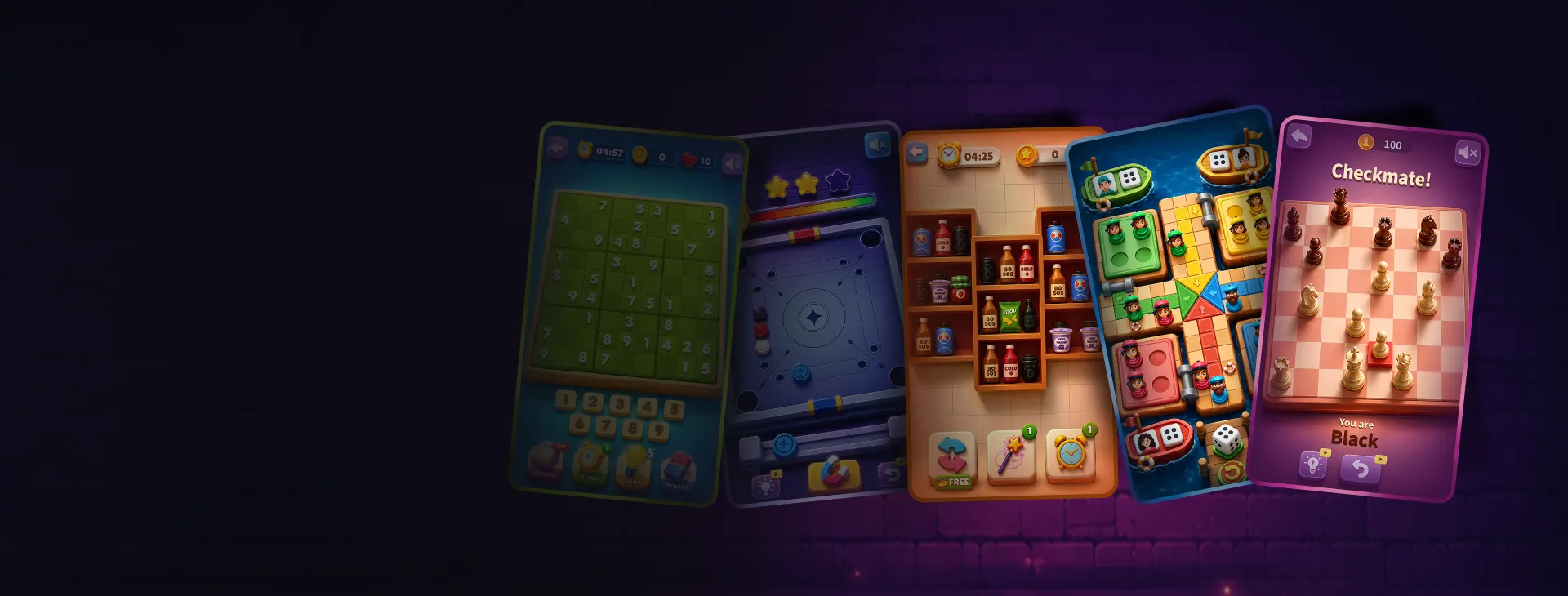
We build HTML5 games for responsive play across desktop and mobile web environments. Production can include gameplay engineering, integrations, performance optimization, and compatibility testing against the agreed browser and device scope.

Delivery Environments
Desktop Web · Mobile Web · Game Portals · Embedded Web

First Playable
4 - 8+ Weeks
Frameworks & Tech
Phaser
Construct 3
Cocos2d-JS
Three.js


Full Production
3-15+ Months
Game Types
Casual
Hyper-Casual
Multiplayer
Puzzle
Strategy
Simulation
Arcade
Social Games

Delivery Targets

30–60 FPS
Scope-Based Target

Target Browsers
Compatibility Testing

Responsive Play
Desktop + Mobile Web
DELIVERY CAPABILITIES
HTML5 GAME PRODUCTION EXPERIENCE
HTML5 game production requires coordinated work across gameplay engineering, rendering, backend systems, browser compatibility, performance optimization, testing, and deployment.
Our team supports complete HTML5 productions as well as development, optimization, porting, integration, and testing work within existing projects.
BROWSER-FIRST
ENGINEERING
HTML5, JavaScript, and suitable rendering frameworks are selected around the game’s performance, complexity, and deployment requirements.
PERFORMANCE ACROSS
DEVICES & BROWSERS
Rendering, input, loading behavior, memory use, and responsive layouts are tested against the browsers and devices included in the project scope.
BACKEND, MULTIPLAYER
& INTEGRATIONS
Multiplayer systems, APIs, authentication, analytics, leaderboards, payments, and other platform services can be integrated as required
BUILDS, PORTING
& ONGOING SUPPORT
Support can cover new HTML5 productions, web ports of existing games, inherited builds, optimization, testing, updates, and maintenance.
HTML5 Game Development Services
HTML5 games serve a wide range of commercial requirements, including casual and promotional titles, multiplayer products, game portals, and web versions of existing games.
Our HTML5 game development services support complete productions as well as focused requirements such as prototyping, backend integration, porting, optimization, testing, and post-launch support.
Full-Cycle HTML5 Game Development
Production planning, gameplay engineering, art and animation integration, backend development, QA, performance optimization, and deployment managed through one coordinated workflow.
HTML5 Game Prototyping & Pre-Production
Early builds help validate gameplay loops, controls, rendering choices, loading behavior, device requirements, and technical feasibility before full production.
Multiplayer & Backend Integration
Real-time multiplayer, matchmaking, authentication, leaderboards, player data, APIs, analytics, and other backend systems are planned around the game’s architecture and scale requirements.
Porting & Codebase Readiness
Existing builds are assessed for code reuse, dependencies, asset adaptation, browser constraints, and maintainability before a migration or modernization scope is defined.
Game Portal & Platform Integration
Portal specifications, embedded environments, existing web platforms, analytics systems, authentication flows, and other integrations are handled as part of the deployment scope.
Testing, Optimization & Ongoing Support
Browser and device testing, rendering and loading optimization, issue resolution, production updates, maintenance, and post-launch technical support are scoped according to the project's release and operational needs.
PLANNING A BROADER GAME PROJECT?
If your requirements extend across platforms, engines, backend systems, art, QA, porting, or post-launch operations, explore our wider game development capabilities.
Explore Game Development ServicesOUR WORK
PROJECTS ACROSS
GENRES & PLATFORMS
Explore game projects where our teams contributed to development, art, backend systems, testing, optimization, or post-launch support.
Each case study outlines the project scope, our production role, and the challenges addressed.




PROJECT PLANNING
FOUR QUESTIONS TO SETTLE
BEFORE HTML5 PRODUCTION
The technical scope depends on the gameplay, target devices and browsers, existing technology, and intended distribution environment. Resolving these questions early helps establish a more realistic production plan.
Is HTML5 the Right Fit for the Game We Have Planned?
Gameplay complexity, 2D or 3D rendering, multiplayer, content volume, target hardware, backend requirements, and distribution goals all affect technology choice. We assess those requirements before recommending HTML5 for production.
Will It Perform Across Our Target Browsers and Devices?
Compatibility is scoped against an agreed browser and device matrix. Rendering, input, loading behavior, memory use, responsive layouts, and frame-rate targets are tested against those environments.
Can Our Existing Game Be Ported to HTML5?
Existing Unity, Flash, native, or other builds can be assessed for web adaptation. The review covers reusable assets and code, dependencies, plugins, backend services, UI and input changes, and browser-performance constraints.
How Will the Game Be Deployed and Distributed?
The deployment scope reflects where the game will live: a company website, game portal, embedded product, campaign, learning platform, or another web environment. Hosting, authentication, analytics, APIs, and payments are planned accordingly.
FLEXIBLE ENGAGEMENT
THREE WAYS TO STRUCTURE YOUR
HTML5 GAME PROJECT
Choose the approach based on your project stage, existing production capacity, and the level of delivery ownership required.
01
YOU NEED END-TO-END DELIVERY
FULL-CYCLE
HTML5 PRODUCTION
A coordinated production team handles planning, gameplay development, backend integration, art implementation, QA, optimization, and deployment against an agreed scope and delivery plan.
Discuss Full-Cycle Development02
YOU ALREADY HAVE A TEAM OR BUILD
HTML5 CO-DEVELOPMENT
& SPECIALIST SUPPORT
Additional HTML5 expertise can be brought into an existing production for gameplay systems, multiplayer, backend integration, porting, performance optimization, browser compatibility, testing, or another defined workstream.
Discuss Co-Development03
YOU NEED CONTINUED PRODUCTION SUPPORT
ONGOING HTML5
DEVELOPMENT & SUPPORT
Continued involvement can cover feature development, performance improvements, compatibility updates, issue resolution, testing, maintenance, and technical support as the game evolves after its initial release.
Plan Ongoing SupportBUDGET & TIMELINE
How Much Does HTML5 Game
Development Cost, And How Long Does It Take?
Gameplay complexity, content volume, multiplayer, backend systems, integrations, and browser coverage all influence HTML5 game development cost and timeline.
Simple 2D / Promotional
10K-25K
Indicative Budget
2 to 3 months
Typical Timeline
Casual
& Feature-Rich 2D
15K-40K
Indicative Budget
3 to 5 months
Typical Timeline
Connected / Backend-Integrated
25K-60K
Indicative Budget
4 to 7 months
Typical Timeline
Multiplayer & Social
40K-100K+
Indicative Budget
6 to 12+ months
Typical Timeline
Complex
3D / WebGL
75K-150K+
Indicative Budget
8 to 15+ months
Typical Timeline
Frequently Asked Questions
HTML5 game monetization can include advertising, sponsorships, licensing, subscriptions, paid access, in-game purchases, and revenue-sharing arrangements with game portals or distribution partners.
The right model depends on the audience, distribution channel, session design, backend requirements, and payment or advertising integrations. Monetization requirements are best defined early because they can influence the game architecture, UI, analytics, and deployment strategy.
For projects where you own the IP, ownership of the project-specific source code, commissioned assets, and other agreed intellectual property is defined in the development agreement and transferred according to those terms.
Third-party frameworks, libraries, plugins, fonts, stock assets, and licensed services remain subject to their respective licenses. These dependencies are identified separately so ownership and usage rights remain clear at handover.
Yes. Red Apple Technologies can sign an NDA before detailed project information is shared.
The NDA can cover unreleased game concepts, source code, artwork, technical documentation, business plans, gameplay systems, and other confidential material. Confidentiality provisions can also continue through the development agreement for the duration of the engagement.
In many cases, yes. An HTML5 game can be adapted or packaged for mobile distribution, depending on its performance requirements, device features, monetization model, integrations, and current app-store requirements.
Some projects can retain much of the existing web codebase, while others require additional mobile-specific engineering, testing, or optimization. If browser and app-store releases are both planned, the deployment approach should be considered during technical planning.
The choice depends on the game's rendering requirements, 2D or 3D scope, gameplay complexity, multiplayer needs, target browsers, asset volume, performance expectations, existing codebase, and long-term maintenance requirements.
Technologies such as Phaser, Construct 3, Cocos2d-JS, and Three.js suit different production scenarios. Rather than applying one framework to every project, the technical stack is selected after the gameplay, deployment environment, and production requirements are understood.
The final deliverables are defined in the project scope and may include the source-code repository, project files, deployment builds, client-owned art and animation assets, technical documentation, build instructions, backend or API documentation, third-party dependency information, and relevant QA or compatibility records.
The handover requirements are agreed before production so there is clarity around ownership, documentation, deployment access, and anything your internal team will need to maintain or extend the game.
Yes. HTML5 games can be integrated into existing websites, game portals, campaign pages, learning platforms, membership products, and other web-based systems.
Depending on the environment, the integration may involve existing authentication, player accounts, APIs, analytics, leaderboards, payment systems, databases, or platform-specific interfaces. Reviewing the host platform early helps define these requirements before development progresses too far.
It depends on the game. A lightweight single-player HTML5 title may primarily require web hosting and efficient delivery of its assets.
Features such as multiplayer, player accounts, persistent progression, cloud saves, leaderboards, payments, live content, or administrative tools usually require additional backend components such as APIs, databases, servers, or real-time services. The infrastructure is therefore scoped around the actual product requirements rather than included by default.
Authentication and player-data architecture are planned around the systems the game needs to connect with. This may include existing user accounts, custom authentication, player profiles, cloud saves, analytics platforms, payment providers, leaderboards, or external APIs.
The implementation accounts for data flows, access permissions, third-party requirements, deployment environment, and the responsibilities of each connected system. Projects with additional security, privacy, or regulatory requirements should identify them during technical discovery so they can be incorporated into the architecture and scope from the outset.
TELL US WHERE YOUR
HTML5 PROJECT STANDS
Get a reply within 24 hours
Tell us where the project stands today. We'll start there.


 Book An Appointment
 WhatsApp