

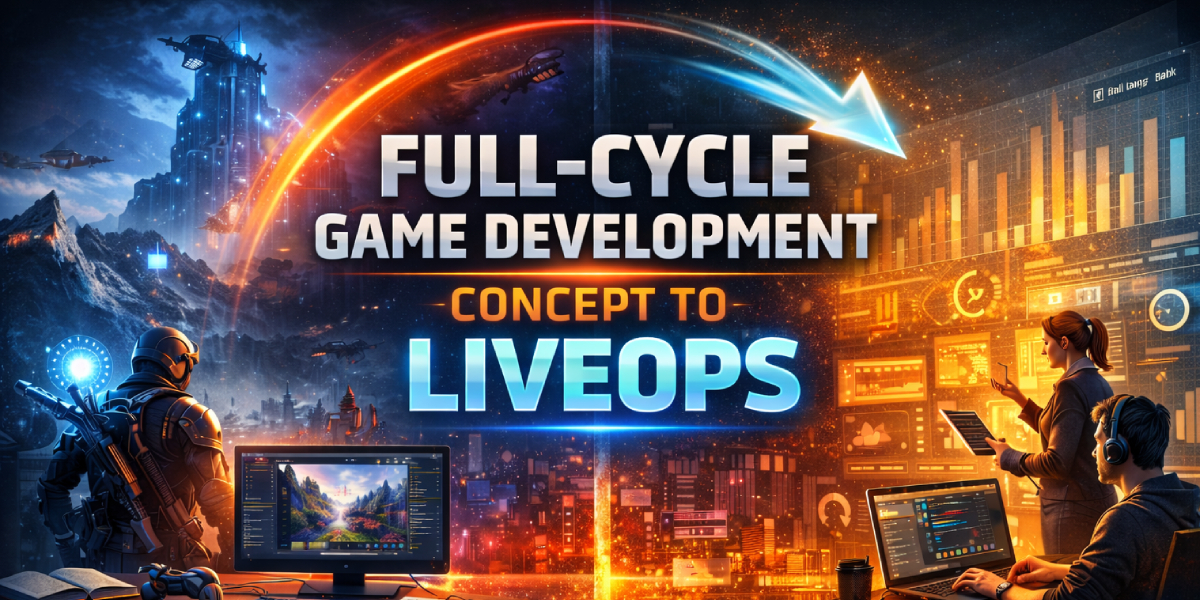
A full-cycle game development approach is not defined by how quickly a game is shipped or how many features it includes at launch. It is defined by how consistently the product is planned, built, released, and evolved over time.
For businesses evaluating an end-to-end game development company, the real differentiator lies in how well a partner manages the entire lifecycle, from early concept validation to LiveOps execution.
This article walks through our full-cycle game development workflow, explaining how much each phase connects logically to the next and why that continuity matters.
Concept Definition and Market Alignment
Every game begins with an idea, but very few ideas are immediately ready for production. The first step in a structured workflow is not development—it is alignment.
At this stage, the focus is on understanding who the game is for, which platforms it should launch on, and how players are expected to engage with it over time. Core gameplay loops, retention mechanics, and differentiation are explored alongside budget and timeline constraints. This prevents teams from committing to concepts that are creatively exciting but operationally unsustainable.
By validating assumptions early, the project can move forward through the game production to LiveOps pipeline without major structural changes later.
Feasibility Assessment and Technical Planning
Once a concept is validated, attention shifts to execution feasibility. This phase determines how the game will actually be built and supported post-launch.
Technical planning involves selecting the appropriate engine, defining backend requirements, and evaluating infrastructure needs based on expected player load and live features. Integrations such as analytics, monetization tools, or multiplayer services are assessed upfront to avoid architectural rework mid-production.
A mature game development company treats this phase as risk management rather than a formality, ensuring scalability and maintainability are built into the foundation.
Game Design and Pre-Production Structure
Pre-production is where clarity replaces ambiguity.
Design documentation, progression systems, UX flows, and visual direction are formalized so that every discipline (design, engineering, art, and QA) shares the same reference point. Rather than locking creativity, this structure enables faster iteration once production begins.
This phase establishes the operational backbone of the full-cycle game development workflow, allowing teams to move into production with shared expectations and minimal friction.
Production: Engineering, Content, and Systems Development
Production is not a single linear sprint toward a final build. It is an iterative process that balances feature development, system stability, and continuous validation.
Gameplay mechanics are developed and refined alongside backend systems, asset pipelines, and platform-specific optimizations. Regular milestones and internal reviews ensure progress remains visible and controlled.
At this stage, many businesses choose to hire full-cycle game developers as a dedicated team, allowing them to scale velocity while maintaining flexibility as requirements evolve.
Quality Assurance and Gameplay Validation
Quality assurance is embedded throughout production rather than isolated at the end.
As features are implemented, they are continuously tested for stability, performance, and gameplay balance. This parallel approach allows teams to identify usability issues, technical bottlenecks, and progression flaws early, when they are still inexpensive to fix.
This discipline supports a smoother transition from production into the game production to LiveOps pipeline, reducing launch risk.
Launch Preparation and Deployment Readiness
Launching a game is an operational milestone, not a finish line.
Before release, builds are validated against platform requirements, backend systems are stress-tested, and monitoring tools are configured to capture real-world performance data. In many cases, a soft launch or phased rollout is used to gather early feedback before full exposure.
An experienced end-to-end game development company treats launch as a controlled transition into live operations rather than a handoff.
LiveOps Strategy and Post-Launch Support
LiveOps is where long-term product value is created.
After launch, attention shifts to monitoring player behavior, stabilizing performance, and delivering meaningful updates. Bug fixes, feature enhancements, and content releases are planned using real data rather than assumptions.
This phase ensures the game continues to evolve in response to its audience, transforming it from static release into a living product.
Analytics, Feedback Loops, and Continuous Improvement
Data plays a central role throughout the lifecycle, but it becomes especially critical post-launch.
Retention trends, engagement depth, progression drop-offs, and feature usage are analyzed to guide roadmap decisions. These insights close the feedback loop between development and LiveOps, reinforcing the integrity of the full-cycle game development workflow.
Team Structure and Long-Term Collaboration
Full-cycle delivery requires continuity across roles and phases.
Rather than rotating teams between production and post-launch, successful projects maintain consistent ownership across engineering, QA, and LiveOps. For this reason, many clients prefer to hire full-cycle game developers under longer-term engagements, preserving knowledge and reducing ramp-up time.
Managing Risk Across the Lifecycle
Risk is addressed incrementally, not reactively.
Early validation prevents overinvestment in weak concepts, while structured production and testing reduce launch instability. Post-launch monitoring ensures scaling and cost management remain predictable as the product grows.
This layered approach keeps delivery adaptable without sacrificing control.
Final Perspective
A full-cycle approach is not about speed alone; it is about sustainability. From concept validation through LiveOps execution, each phase supports the next, ensuring the product can grow alongside its audience and market conditions.
For businesses evaluating a game development company, understanding how a partner manages the entire lifecycle, from production through LiveOps, provides clarity, reduces risk, and sets realistic expectations for long-term success.
To Have A Better Understanding On This Let us Answer The Following Questions
Answer: A full-cycle game development workflow typically covers concept validation, game design, production, quality assurance, launch preparation, and LiveOps support. Unlike partial services, it ensures continuity across the entire game production to LiveOps pipeline, with one team accountable from start to finish.
Answer: An end-to-end game development company focuses on building games as client-owned products, managing structured processes, timelines, and post-launch support. A game studio often prioritizes internal IP creation and publishing, which can limit flexibility for client-driven requirements.
Answer: Businesses usually hire full-cycle game developers when the project requires long-term support, frequent iteration, or LiveIps involvement. Dedicated full-cycle teams reduce coordination overhead and preserve product knowledge across production and post-launch phases.
Answer: Not always. Some providers stop at launch and treat LiveOps as a separate engagement. Clients should confirm upfront whether post-launch monitoring, updates, analytics, and infrastructure scaling are included as part of the game production to LiveOps pipeline.
Answer: Look for experience in post-launch support, analytics integration, server scaling, and content update planning. A capable game development company should explain how it monitors player behavior, prioritizes updates, and manages long-term product stability.
Answer: There is no one-size-fits-all model. Fixed-scope engagements work for well-defined projects, while dedicated teams are better for evolving products. Many companies use hybrid models that balance predictability with flexibility when working with an end-to-end game development company.
Answer: Timelines depend on scope, platform, and complexity. Smaller games may reach launch within a few months, while larger or multiplayer projects can take significantly longer. LiveOps support typically extends indefinitely based on business goals and player engagement.
Answer: Clients should clarify IP ownership, documentation deliverable, scope-change handling, QA processes, LiveOps responsibilities, and team continuity. Clear answers to these questions indicate a mature, professional engagement model.




 Book an Appointment
 Get Instant Project Estimation
 WhatsApp Now
 Select Files From Your


 Book An Appointment
 WhatsApp