

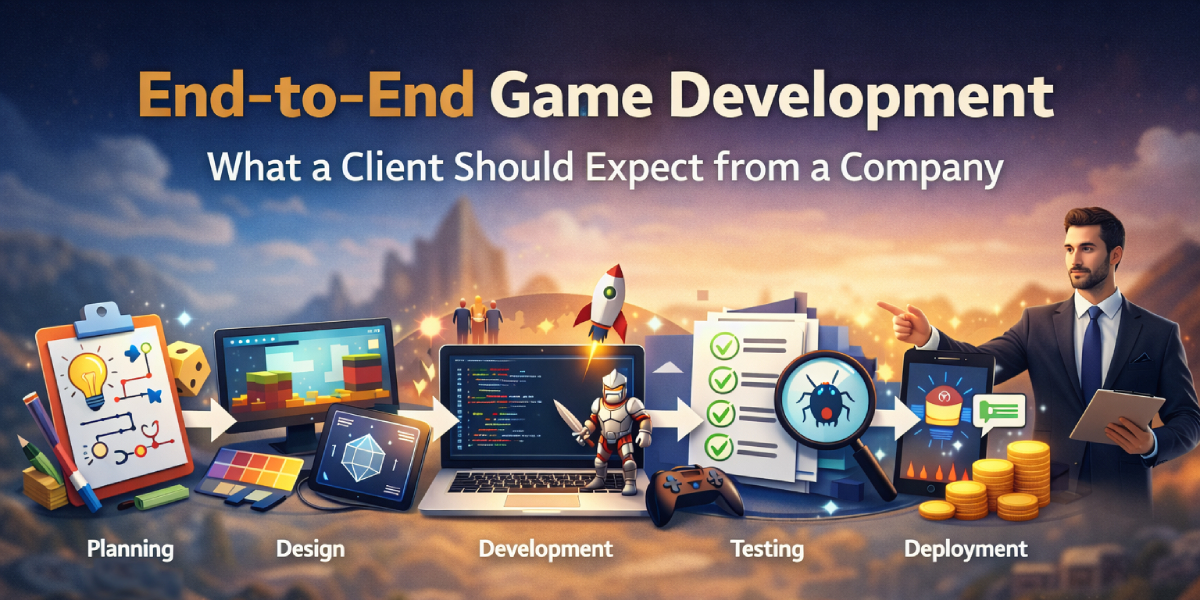
Choosing the right game development company is not just about creative output or technical expertise; it’s about understanding how a project moves through the end-to-end game development process, from early planning to post-launch support.
For startups, enterprises, and digital brands, clarity around expectations helps reduce risk, control costs, and ensure smoother collaboration with a professional game development company.
What Is End-to-End Game Development?
End-to-End game development refers to a full-cycle approach where one partner manages the entire lifecycle of a game product. Instead of coordinating multiple vendors, clients work with a single company responsible for strategy, production, testing, and ongoing support.
Most full-cycle game development services include:
- Ideation and feasibility analysis
- Game design and prototyping
- Engineering and asset production
- Quality assurance and deployment
- Post-launch updates and live operations
This model is particularly useful for clients who want accountability and long-term continuity.
Phase 1: Discovery, Ideation, and Feasibility
The discovery phase defines whether an idea is viable and how it should be executed.
What Clients Should Expect:
- Requirement discovery sessions
- Target platform and audience analysis
- Core mechanics and progression planning
- Monetization and engagement discussions
- Technical feasibility checks
A reliable professional game development company will refine ideas, identify constraints, and align creative ambition with technical reality.
Phase 2: Game Design & Pre-Production
Pre-production transforms ideas into executable plans.
Typical Deliverable:
- Game Design Document (GDD)
- User flow diagrams and progression systems
- Visual direction and art references
- Wireframes and early prototypes
- Tooling and technology selection
This stage prevents scope creep and ensures alignment before production begins.
Phase 3: Development & Production
Production is the most resource-intensive stage of the end-to-end game development process.
Core Development Activities:
- Frontend and backend development
- Gameplay logic and system integration
- Multiplayer and real-time features (if required)
- Asset integration (2D, 3D, audio)
- Platform optimization
At this stage, some clients choose to hire dedicated game developers to accelerate delivery or maintain flexibility as requirements evolve.
Phase 4: Quality Assurance & Testing
Testing is essential to delivering a stable and engaging product.
What Full-Cycle Testing Includes:
- Functional and regression testing
- Performance and load testing
- Cross-device and cross-platform validation
- Gameplay balance and UX testing
- Bug tracking and resolution
A structured QA pipeline is a hallmark of a mature game development company.
Phase 5: Deployment & Launch Support
Launching a game involves technical, operational, and compliance considerations.
Launch Support Typically Covers:
- Store or platform submission assistance
- Build optimization and configuration
- Analytics and monitoring setup
- Soft launches or phased rollouts
Clients should expect hands-on support during this critical phase, not just a handover of files.
Phase 6: Post-Launch Support & Live Operations
True full-cycle game development services extend beyond launch.
Post-Launch Expectations:
- Bug fixes and performance optimization
- Feature enhancements and content updates
- Live-ops and event support
- Player behavior analytics
- Scalability planning
For long-term products, clients may continue to hire dedicated game developers to support iteration and growth.
Engagement Models in End-to-End Game Development
Most professional providers offer multiple engagement options:
- Fixed Scope: Best for clearly defined projects with minimal change.
- Dedicated Teams: Ideal for startups and evolving products that require ongoing development.
- Hybrid Models: Local coordination combined with global execution for cost and scale efficiency.
A transparent professional game development company will explain which model best suits your goals rather than forcing a one-size-fits-all approach.
Key Questions Clients Should Ask
Before finalizing a partner, clients should ask:
- Who owns the intellectual property?
- What documentation is included?
- How are scope changes handled?
- What post-launch support is available?
- How is communication structured?
Clear answers indicate a reliable game development company.
Red Flags to Watch For
Be cautious if a company:
- Avoids documentation or planning
- Promises unrealistic timelines
- Lacks a defined QA process
- Cannot explains its technical decisions
These often indicate gaps in the end-to-end game development process.
Final Thoughts
End-to-end game development is about more than building a playable product; it’s about delivering a sustainable, scalable solution through a structured and transparent process.
By working with a professional game development company that offers true full-cycle game development services, clients can reduce risk, maintain clarity, and build products designed for long-term success.
To Have A Better Understanding On This Let us Answer The Following Questions
Answer: The end-to-end game development process usually covers discovery, game design, development, testing, deployment, and post-launch support. A professional game development company manages all these phases under one engagement to ensure continuity and accountability.
Answer: Full-cycle game development services reduce coordination effort, minimize risks caused by handoffs, and provide a single point of responsibility. This approach is especially useful for startups building MVPs and enterprises launching scalable, long-term game products.
Answer: Businesses typically hire dedicated game developers when requirements are evolving, timelines are flexible, or ongoing updates are planned. Dedicated teams offer better adaptability than fixed-scope models, particularly for live games or platforms under continuous development.
Answer: Look for evidence of structured processes across all phases: planning, development, QA, deployment, and post-launch support. A reliable game development company should clearly explain workflows, documentation, and long-term support rather than focusing only on production.
Answer: Key questions include:
- What phases of development do you handle internally?
- How do you manage scope changes?
- What QA and testing processes are included?
- Who owns the IP and source code?
- What post-launch support is offered?
Clear, detailed answers indicate a mature provider.
Answer: Not always. Some providers treat post-launch support as a separate engagement. Clients should confirm upfront whether maintenance, updates, live operations, and scaling are included in the full-cycle game development services or billed separately.
Answer: Timelines vary depending on complexity, platform, and scope. Simple mobile games may take a few months, while larger or multiplayer projects can take significantly longer. A professional game development company should provide realistic timelines with milestone-based planning.
Answer: Timelines vary depending on complexity, platform, and scope. Simple mobile games may take a few months, while larger or multiplayer projects can take significantly longer. A professional game development company should provide realistic timelines with milestone-based planning.
Answer: Yes. Many companies use hybrid models that combine local coordination with remote or offshore development teams. When managed properly, this approach offers flexibility, cost efficiency, and access to a wider talent pool without compromising delivery quality.




 Book an Appointment
 Get Instant Project Estimation
 WhatsApp Now
 Select Files From Your


 Book An Appointment
 WhatsApp