


Cost to Hire a Game Development Company: A Country-Wise Breakdown
One of the first questions businesses ask when planning a game project is deceptively simple: How much does it cost to hire a game development company?
The reality is that game development costs vary widely, not just based on project scope or technology, but also on where the development partner is located.
This article provides a realistic look at game development cost by country, explains why prices differ across regions, and helps decision-makers understand how to evaluate cost versus value when choosing a development partner.
Why Game Development Costs Vary by Country
Game development pricing is influenced by more than hourly rates. While geography plays a major role, cost differences are also shaped by:
- Talent availability and maturity of the local ecosystem
- Cost of living and wage standards
- Technical specialization and experience level
- Engagement models and operational overhead
- Communication, timezone alignment, and project management maturity
As a result, two companies quoting vastly different prices may not be offering the same depth of service, scalability, or delivery assurance.
Common Pricing Models Used by Game Development Companies
Before looking at country-wise costs, it’s important to understand how pricing is typically structured. Most top game development companies operate under:
- Fixed-price model: Best for clearly defined scopes
- Hourly / time-based model: Suitable for evolving requirements
- Dedicated team model: Ideal for long-term development and LiveOps
The chosen model significantly affects the final cost and should align with project complexity and timeline certainty.
Game Development Cost by Country (With Price Ranges)
The following figures are indicative estimates for mobile, casual, and mid-core games of moderate complexity. AAA console titles or highly complex multiplayer games may exceed these ranges.
India
Estimated Cost Range: $60,000 – $300,000
India is one of the most cost-effective destinations to hire game developers globally while maintaining scalability. Indian game development companies are known for:
- Large, diverse talent pools
- Flexible engagement models
- Strong experience in mobile, casual, and service-based games
- Cost-efficient long-term development and LiveOps support
India is often considered when businesses seek an affordable game development company for extended development cycles.
United States
Estimated Cost Range: $200,000 – $1,200,000
The US is one of the most expensive regions to hire a game development company, driven by high labor costs and operational overheads. US-based companies are often selected for:
- Technically complex or enterprise-grade projects
- Advanced multiplayer and backend systems
- Strong project governance, documentation, and legal alignment
While pricing is high, many businesses choose US partners when risk mitigation, proximity, and deep technical specialization are priorities.
Canada
Estimated Cost Range: $180,000 – $900,000
Canada has a well-established game development ecosystem supported by government incentives and a strong talent pipeline. Canadian companies typically offer:
- High production and engineering standards
- Experience across mobile, PC, console, and cross-platform titles
- Structured workflows similar to US studios
Costs are slightly lower than the US, making Canada a middle ground between premium quality and moderate optimization.
China
Estimated Cost Range: $100,000 – $500,000
China has a massive game development workforce, particularly in mobile and live-service games. Its strength includes:
- High-volume production capability
- Strong monetization and engagement mechanics
- Competitive pricing for large teams
However, language barriers, IP protection, and regulatory considerations require careful planning.
Southeast Asia (Vietnam, Philippines, Indonesia)
Estimated Cost Range: $50,000 – $280,000
Southeast Asia is an emerging hub for mobile and casual game development. Studios in this region are commonly chosen for:
- Cost-effective production support
- Growing expertise in art, animation, and mobile development
- Smaller, focused teams
While pricing is attractive, buyers should assess scalability and long-term delivery maturity carefully.
Western Europe (UK, Germany, France, Nordics)
Estimated Cost Range: $170,000 – $850,000
Western European studios emphasize process discipline, compliance, and long-term product stability, They are often chosen for:
- Enterprise-grade or regulated projects
- Strong documentation and IP protection
- Long-term partnerships requiring predictability
Higher costs are driven by labor regulations and living standards, but reliability is a key differentiator.
Eastern Europe (Poland, Ukraine, Romania, Czech Republic)
Estimated Cost Range: $90,000 – $450,000
Eastern Europe has become a popular outsourcing destination due to its strong engineering talent and competitive pricing. Key advantages include:
- Solid backend and gameplay engineering expertise
- Familiarity with Eastern workflows and tools
- Better cost-efficiency than Western Europe
This region is frequently selected for hiring cost comparison for developers where quality and affordability must coexist.
Middle East (UAE)
Estimated Cost Range: $150,000 – $700,000
The UAE is an emerging gaming and technology hub with increasing regional investment. Companies here are typically chosen for:
- Strategic presence in the MENA region
- Localization and regional expansion goals
- Strong infrastructure but higher operating costs than Asia
The UAE is rarely the lowest-cost option but plays a role in regional business strategy.
Game Development Cost Breakdown by Game Type & Region
The following tables represent indicative market ranges for a professional game development company delivering production-ready games. Actual costs vary by scope, timeline, and engagement model.
1. Casual & Hyper-Casual Game Development Costs
Game Types: Puzzle, Match-3, Runner, Arcade, Simple Simulation
Development Duration: 2–4 months
Backend Complexity: Low to minimal
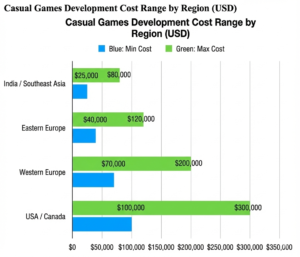
Cost Table: Casual Games
| Region | Estimated Cost Range (USD) |
|---|---|
| India / Southeast Asia | $25,000 – $80,000 |
| Eastern Europe | $40,000 – $120,000 |
| Western Europe | $70,000 – $200,000 |
| USA / Canada | $100,000 – $300,000 |
How much does it cost to build a casual or hyper-casual game?
The cost typically ranges from $250,000 to $80,000 in cost-efficient regions and up to $300,000 in premium markets. Final pricing depends on the number of mechanics, art style, analytics, and ad monetization setup.
How long does it take to develop a casual mobile game?
Most casual games take 2–4 months from concept to launch. Timelines increase if live events, A/B testing, or post-launch optimization are included.
Should startups hire a game development company or freelancers for casual games?
While freelancers may appear cheaper, a professional game development company offers structured delivery, QA, and post-launch support, reducing long-term risk even for simple games.
2. Mid-Core Mobile Game Development Costs
Game Types: RPG-lite, Strategy, Action, Card, Tycoon
Development Duration: 4–8 months
Backend Complexity: Medium (cloud saves, progression, IAP)
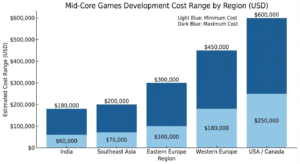
Cost Table: Mid-Core Games
| Region | Estimated Cost Range (USD) |
|---|---|
| India | $60,000 – $180,000 |
| Southeast Asia | $70,000 – $200,000 |
| Eastern Europe | $100,000 – $300,000 |
| Western Europe | $180,000 – $450,000 |
| USA / Canada | $250,000 – $600,000 |
Buyer Insight:
This is the most common category for funded startups and publishers. Choosing the right game development partner here affects scalability, monetization, and LiveOps success.
What is the average cost of a mid-core mobile game?
Mid-core mobile games generally cost between $60,000 and $600,000, depending on region, progression systems, backend complexity, and art quality.
What features increase the cost of mid-core games the most?
The biggest cost drivers are:
- Progression and economy balancing
- Cloud saves and player accounts
- In-app purchases and monetization logic
- Ongoing content updates
These systems require experienced engineers and designers.
Is it better to hire a dedicated team for mid-core game development?
Yes. Many studios choose a dedicated team model for mid-core games because it allows flexibility, faster iteration, and smoother LiveOps support as the game evolves.
3. Multiplayer & Online Game Development Costs
Game Types: PvP, Co-op, RTS, Social, Shooter
Development Duration: 6–12+ months
Backend Complexity: High (matchmaking, servers, security)
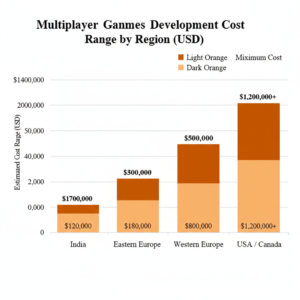
Cost Table: Multiplayer Games
| Region | Estimated Cost Range (USD) |
|---|---|
| India | $120,000 – $350,000 |
| Eastern Europe | $180,000 – $500,000 |
| Western Europe | $300,000 – $800,000 |
| USA / Canada | $500,000 – $1,200,000+ |
Important Note:
Backend architecture, server scaling, and LiveOps can account for 30–40% of total cost in multiplayer games.
Why are multiplayer games more expensive to develop?
Multiplayer games require:
- Server architecture and matchmaking
- Security and anti-cheat systems
- Scalability for concurrent users
- Continuous monitoring and balancing
These elements significantly increase both development and operational costs.
What is the minimum budget for a multiplayer game?
A production-ready multiplayer game usually starts around $120,000–$180,000 in cost-efficient regions and can exceed $1M+ in North America for complex implementation.
Can a game development company handle LiveOps for multiplayer games?
Yes, but not all companies specialize in LiveOps. Buyers should confirm experience in server scaling, analytics, and post-launch content delivery before hiring a development partner.
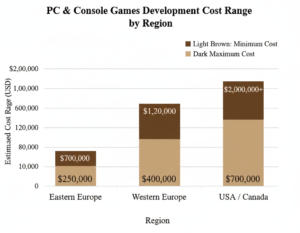
4. PC & Console Game Development Costs
Game Types: Premium PC titles, AA console games
Development Duration: 8–18 months
Key Cost Drivers: Art fidelity, optimization, certification
Cost Table: PC & Console Games
| Region | Estimated Cost Range (USD) |
|---|---|
| Eastern Europe | $250,000 – $700,000 |
| Western Europe | $400,000 – $1,200,000 |
| USA / Canada | $700,000 – $2,000,000+ |
Why is PC and console game development more expensive than mobile?
PC and console games demand:
- Higher asset fidelity
- Performance optimization
- Platform certification and compliance
- Extensive QA and testing
These requirements increase development time and team size.
How long does it take to build a PC or console game?
Most PC and console games take 8–12 months, depending on scope, platform count, and technical complexity.
Should studios hire a specialized console game development company?
Yes. Console development requires platform-specific expertise. Hiring a professional game development company with certification experience reduces approval delays and rework.
5. LiveOps, Maintenance & Ongoing Support Costs
Applies to: Mid-core, multiplayer, and long-term games
Billing Model: Monthly / Retainer-based
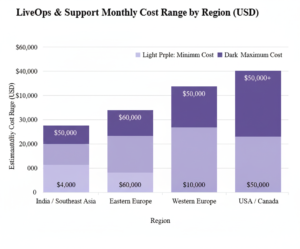
Cost Table: LiveOps & Support
| Region | Monthly Cost Range (USD) |
|---|---|
| India / Southeast Asia | $4,000 – $12,000 |
| Eastern Europe | $6,000 – $18,000 |
| Western Europe | $10,000 – $30,000 |
| USA / Canada | $15,000 – $50,000+ |
Includes:
- Bug fixes and updates
- Content drops and events
- Server monitoring
- Balancing and optimization
What does LiveOps cost after game launch?
LiveOps typically costs $4,000 to $50,000+ per month, depending on region, team size, and level of ongoing content and support.
Is LiveOps mandatory for all game types?
LiveOps is essential for:
- Mid-core mobile games
- Multiplayer and online games
Casual games may require lighter post-launch support but still benefit from updates and performance monitoring.
Can LiveOps be outsourced to a different game development partner?
Yes, but transitioning LiveOps to a new team can increase risk. Many studios prefer working with the original development company for continuity and efficiency.
Understanding regional pricing is only the first step. The real cost efficiency comes from choosing a game development company that aligns with your game type, timeline, and long-term goals.
Cost vs. Value: What Businesses Often Miss
Choosing the lowest-priced option rarely results in the lowest total cost. Hidden expenses often come from:
- Rework due to unclear communication
- Weak documentation and process gaps
- Poor scalability during LiveOps
- Limited post-launch support
A slightly higher upfront investment with a reliable game development company can reduce risk, shorten timelines, and improve long-term outcomes.
What Impacts Your Final Cost More Than Location
While geography matters, scope and complexity often matter more. Key cost drivers include:
- Platform targets (mobile, PC, console, cross-platform)
- Multiplayer and backend infrastructure
- Art and animation complexity
- LiveOps, analytics, and monetization systems
- Ongoing maintenance and content updates
Two projects in the same country can differ dramatically in cost depending on these factors.
How to Choose the Right Country for Your Project
Instead of asking “Which country is cheapest?”, buyers should ask:
- What level of technical expertise do we need?
- Will this project require long-term LiveOps support?
- How important is timezone overlap and communication?
- Do we need a dedicated team or fixed-scope delivery?
The best decision balances cost, capability, and long-term partnership potential.
Conclusion
A clear understanding of game development cost by country helps businesses budget realistically, but price alone should never drive the decision. The real value of hiring a game development company lies in delivery, reliability, technical alignment, scalability, and post-launch support.
By combining cost awareness with careful evaluation, businesses can confidently hire game developers globally and turn budgets into successful, sustainable game products.
To Have A Better Understanding On This Let us Answer The Following Questions
Answer: You can estimate your game’s cost by answering four key questions:
- What type of game are you building (casual, mid-core, multiplayer, PC/console)?
- Which platforms will it support (mobile, PC, console, cross-platform)?
- Will it include multiplayer, backend, or LiveOps features?
- Which region do you plan to hire game developers from?
Combining these factors gives a realistic early-stage budget range.
Answer: For a production-ready game:
- Casual games typically start at $25,000+
- Mid-core games start around $60,000+
- Multiplayer games usually require $120,000+
Anything significantly lower often excludes QA, backend stability, or post-launch support.
Answer: Platform selection has a major impact:
- Mobile-only: Lowest cost
- PC or console: Higher due to optimization and certification
- Cross-platform: Adds 20–40% due to shared logic, testing, and performance tuning
More platforms mean more development and QA effort.
Answer: Each feature layer increases scope:
- Multiplayer → +30–50%
- LiveOps & events → +15–30%
- Analytics & A/B testing → +10–20%
- Advanced monetization → +10–25%
A good cost estimate accounts for both build and long-term operation.
Answer: Location changes labor costs but not complexity:
- Hiring from India or Southeast Asia lowers costs
- Eastern Europe offers a balance of quality and pricing
- North America and Western Europe are premium-priced
This is why game development cost by country is a key input in budgeting.
Answer: Early budgeting is easier using total project cost. Hourly rates vary widely and can be misleading without understanding team size and timeline.
Professional buyers often convert estimates into monthly team costs for clarity.
Answer: Many budgets fail because they exclude:
- QA and regression testing
- Backend hosting and cloud costs
- App store fees and compliance
- LiveOps and post-launch updates
A reliable estimate always includes these elements.
Answer: Yes, by:
- Starting with an MVP
- Limiting platforms at launch
- Choosing a dedicated team in a cost-efficient region
- Phasing features post-launch
Smart scope control matters more than choosing the cheapest vendor.
Answer: A calculator provides a range, not a final quote. Accuracy improves after:
- Technical discovery
- Feature breakdown
- Platform confirmation
Most professional game development companies refine estimates after a short discovery phase.
Answer: You should request a full breakdown once:
- Your game type is finalized
- Core features are defined
- Target platforms are clear
This ensures estimates are actionable and contract-ready.
Get Started
- End-to-End Game & App Development Services
- Flexible Business Models – Project Based or Dedicated Hiring
- 13+ Years of Industry Experience with Global Clientele
- Globally Recognized by Clutch, GoodFirms & DesignRush
Related Blogs
Discover more stories & insights that inspire
There’s a moment in almost every Unreal project where progress starts to feel heavier. Not slower in an obvious way, but heavier. Features take longer to implement. Fixes don’t stay...
The wrong partner doesn’t fail your project on day one. It fails itself slowly through delays, compliance gaps, and missed market windows. In the iGaming industry, your technology partner is...

A $100 billion market. Millions of bets placed every minute. And most new operators still get the cost wrong. Not because the opportunity isn’t real, but because they underestimate the...
A game aggregator is not just another software product. For investors, it is better understood as infrastructure: a platform that connects many game providers, delivers content through one system, and...
As the third-largest market in Europe, France is gradually making its presence felt in the global game industry. With over 500 million game studios and a vibrant gaming population of...
Singapore is fast evolving into the global gaming landscape. As a prominent game development destination, the country is attracting investors, startups, and businesses of all sizes. Already, this Asian country...
Italy has quietly developed into one of Europe’s most creative mobile game development ecosystems. While the country may not match the scale of mobile gaming markets like the United States...
South Korea is one of the most advanced gaming ecosystems in the world. With high-speed 5G infrastructure, strong government support for immersive technology, and a deeply rooted competitive gaming culture,...
Turkey has become one of the fastest-growing mobile gaming ecosystems in Europe. Over the past decade, mobile game developers in Turkey have produced globally successful casual and hyper-casual titles, attracted...
How we design, test, and launch interactive experiences is changing rapidly with the inclusion of generative AI in game development. Gone are the days of using artificial intelligence as a...


 Book An Appointment
 WhatsApp