


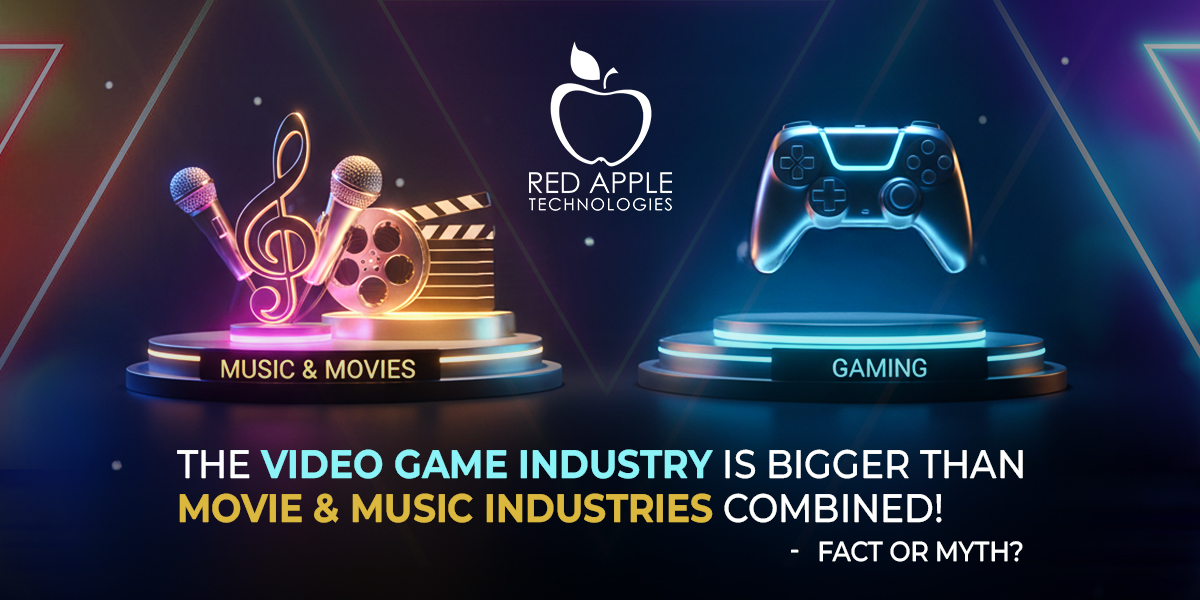
The gaming industry is massive! Whether it is console, PC, mobile, or cloud, the sector has boomed over the years. Developer, publisher, marketer, or even gamer, everybody’s making big bucks. In simple terms, the entertainment economy is undergoing a profound shift.For decades, movies and music dominated the cultural conversation and the investment spotlight. Today, however, gaming is not only rivaling but surpassing both industries in revenue, growth velocity, and investor appeal. The gaming industry has matured into a global ecosystem of recurring digital revenues, transmedia intellectual property (IP), and scalable live operations, all of which make it structurally more lucrative for investors and creators alike. For those evaluating the gaming industry ROI, the numbers speak for themselves.
The Scale of Gaming Compared to Movies and Music
The size of the global games market dwarfs its cultural peers. Industry reports estimate worldwide gaming revenues at nearly $188–189 billion in 2024-2025, while recorded music revenue sits at roughly $30 billion and the global box office at just over $30 billion.
The disparity is more than a matter of raw numbers. It illustrates a wider pattern within entertainment industry trends: audiences are spending more time and money in interactive worlds than in passive consumption. A single blockbuster film may enjoy a few weeks of box office dominance, and a hit album may stream for months, but a successful game can generate income for years through expansions, updates, microtransactions, and subscriptions.
The market also has validation from capital flows. Microsoft’s $68.7B acquisition of Activision Blizzard in 2023 was not simply a large deal — it was a signal. It showed that the biggest technology companies see games not as ancillary content but as foundational to future subscription ecosystems and digital entertainment platforms.
Why Games Generate Superior ROI
Unlike other media, games thrive on engagement loops that extend well beyond initial release windows. Three dynamics in particular help explain why gaming industry ROI can surpass that of movies and music:
- Continuous monetization: Games monetize players over time through season passes, battle passes, and microtransactions.
- Digital-first economies: With the majority of revenue now digital, incremental sales carry high margins compared to physical distribution.
- Live operations: New events, characters, and updates extend a game’s lifecycle, producing compound returns over years.
For entrepreneurs and studios, these mechanisms highlight why demand for mobile game services is rising sharply. Mobile remains the largest slice of the gaming economy, and titles that integrate strong live-ops systems on smartphones can scale faster and reach broader audiences than any single film or album.
Case Study 1: Fortnite as a Cultural and Financial Juggernaut
When Epic Games launched Fortnite: Battle Royale in 2017, few predicted it would become one of the most profitable entertainment products in history. Within its first two years, Fortnite generated over $9 billion in revenue, largely through cosmetic microtransactions and battle passes. By 2024, it had cemented itself as a multi-billion-dollar ecosystem rather than a single game.
What made Fortnite extraordinary was its ability to merge gaming with cultural events. The Travis Scott in-game concert in 2020 attracted over 27 million players, far surpassing the capacity of any real-world stadium and setting a new benchmark for digital live events. Similar collaborations with brands like Marvel, Nike, and Star Wars turned the game into a platform for transmedia storytelling and advertising.
From an investor’s perspective, Fortnite illustrates every advantage the gaming industry has over movies and music:
- Recurring monetization through seasonal passes and skins
- Live operations that keep engagement cycles fresh year after year
- Franchise leverage into merchandise, collaborations, and brand partnerships
- Platform positioning, where Epic is now building the “Fortnite ecosystem” as a proto-metaverse
For developers and publishers, it demonstrates the power of designing not just a game but a platform. For entrepreneurs, it highlights the need to hire game developers who understand not only code but also engagement systems, data analytics, and cross-media integration.
Case study 2: League of Legends and the Power of Esports Longevity
If Fortnite exemplifies how gaming fuses culture with digital events, League of Legends (LoL) demonstrates how a title can sustain decade-long ROI through competitive ecosystems. Launched in 2009 by Riot Games, LoL remains one of the most played PC games globally, boasting over 180 million monthly active players at its peak and generating more than $2 billion annually in recent years.
The key to LoL’s enduring success lies in its esports integration. Riot didn’t just launch a game; they built an entire competitive infrastructure around it, including professional leagues, regional tournaments, and the globally celebrated League of Legends World Championship. The 2023 Worlds event drew over 6 million peak concurrent viewers, rivaling major traditional sports broadcasts.
From an ROI perspective, LoL shows that profitability doesn’t always require reinventing mechanics every few years. Instead, it thrives on:
- Stable core gameplay that allows consistent player mastery.
- Seasonal updates that refresh the meta without fragmenting the player base.
- Esports ecosystems that attract sponsorships, ticketing, merchandising, and streaming deals.
- Cross-media expansion, from animated series (Arcane on Netflix) to music collaborations that extend the IP into new audiences.
For investors, League of Legends proves that long-term returns in gaming can come from platform-like stability rather than rapid reinvention. For developers and studios, it underlines the potential of creating IP that extends into esports, streaming, and even mainstream media.
Case study 3: Minecraft and the Economics of Community-Driven Ecosystems
If Fortnite thrives on cultural crossovers and League of Legends on esports longevity, Minecraft showcases the extraordinary ROI power of user-generated content (UGC). Released in 2009 and acquired by Microsoft in 2014 for $2.5 billion, Minecraft has since become the best-selling game of all time, with over 300 million copies sold and a daily active user base in the tens of millions.
Unlike traditional titles, Minecraft’s profitability lies in community empowerment rather than developer-driven updates alone. Its sandbox design turned players into creators, enabling them to build entire worlds, mods, skins, and even custom servers. This UGC model sustains constant novelty, with the community itself generating experiences that attract new players and keep veterans engaged.
From an investment and development perspective, Minecraft demonstrates three unique strengths:
- Infinite replayability: The game’s open-ended sandbox design ensures there is no “end,” allowing players to continue experimenting indefinitely.
- UGC-driven monetization: Through the Minecraft Marketplace, creators can sell mods, skins, and maps, producing revenue not only for themselves but also for Microsoft.
- Cross-platform scalability: Available on PC, console, mobile, and even VR, Minecraft shows how mobile game development services can play a role in expanding reach.
- Educational and enterprise adoption: Minecraft: Education Edition illustrates the IP’s versatility, opening revenue channels in schools and training programs, a dimension most movies and music products never touch.
What makes Minecraft particularly appealing for investors is its resilience. Unlike hit-driven games, it isn’t dependent on “launch hype” but on ecosystem sustainability. The content loop is decentralized: developers provide the tools, and the community keeps building. This creates a self-perpetuating economy where ROI continues long after initial purchase.
For entrepreneurs, publishers, and studios, Minecraft proves that sometimes the best returns come from enabling creativity rather than dictating it. For developers, it highlights the importance of modularity, extensibility, and community-friendly tools.
Comparative table — Fortnite vs. League of Legends vs. Minecraft
Below is a compact, investor-friendly comparison you can paste into decks or due-diligence notes. I kept it focused on the ROI model, primary revenue drivers, longevity strategy, core KPIs to watch, main risks, and recommended investor actions.
| Dimension | Fortnite (Epic) Live events & cultural platform | League of Legends (Riot) Esports & competitive longevity | Minecraft (Mojang/Microsoft) UGC & community ecosystem |
|---|---|---|---|
| ROI Model | Hit-driven + recurring microtransactions and battle passes; platform upside from transmedia deals. | Stable, long-term recurring monetization from skins/DLC + esports sponsorships and media. | Durable, low-churn ROI driven by perpetual UGC activity and marketplace monetization. |
| Primary Revenue Drivers | Cosmetic sales, battle passes, limited-time events, brand collaborations, in-game advertising. | Cosmetic & skin sales, event ticketing/sponsorship, media licensing, franchised leagues. | Initial game sales, marketplace commissions, Education/enterprise licenses, cross-platform ports. |
| Longevity Strategy | Constant live-ops, cultural tie-ins (concerts, brand collabs), seasonal content. | Seasonal competitive cycles, franchised leagues, developer support for balance. | Enable creators (mods, maps), cross-platform compatibility, tools for creators. |
| Typical KPIs to Watch | DAU/MAU, retention (D1/D7/D30), event-driven spikes, LTV:CPI for UA. | MAU & peak concurrent viewers for esports, ARPPU, retention cohorts. | Active creators count, marketplace GMV, daily installs, engagement depth. |
| Main Risks | Hit-dependency, UA cost spikes, IP/brand fatigue, regulatory scrutiny. | Competitive balance failures, regional esports regulation, viewership trends. | Platform complacency, monetization limits, community fragmentation. |
| Best Investor Play | Back platform-scale live-ops studios, adtech partners, strategic IP plays. | Invest in studios with strong esports roadmaps, franchising partnerships. | Target marketplaces, creator tools, studios that empower UGC. |
| Fit for Mobile/Services | Highly mobile-capable; integrates well with mobile game services. | PC-first but expanding to mobile; mobile ports increase reach. | Strong cross-platform presence; services accelerate discovery. |
Quick notes for investors
- Fortnite shows how event-driven culture multiplies short-term revenue into long-term platform value; expect high volatility but large upside.
- League of Legends is a blueprint for steady, franchise-like returns built around competitive ecosystems and predictable seasonal revenue.
- Minecraft proves that enabling creators can produce resilient, long-duration ROI with lower marketing dependency.
Risks and Challenges to Keep in Mind
The industry’s growth is not without volatility. Venture-backed gaming exits hit an eight-year low in 2024, reminding investors that while long-term potential is robust, short-term liquidity is not guaranteed.
Success also remains highly hit-driven. For every global phenomenon like Fortnite, dozens of games underperform or fail to reach profitability. Rising user acquisition (UA) costs add further risk, especially in mobile markets where games must carefully balance cost per install (CPI) against lifetime value. Regulatory scrutiny around loot boxes and platform fees poses another challenge, particularly for smaller studios that rely on thin margins.
The Investor and Operator’s KPI Toolkit
Investors and entrepreneurs evaluating opportunities in gaming must focus on the metrics that reveal retention and monetization potential. Daily and monthly active user counts demonstrate reach, but it is the retention curve (how many players stick around after day 1, 7, and 30) that predicts whether a game can sustain long-term monetization.
Equally important is understanding revenue per user. Metrics such as ARPU (average revenue per user) and ARPPU (average revenue per paying user) illustrate not only whether players engage but whether they convert. These numbers should be considered alongside LTV:CAC ratios (lifetime value relative to customer acquisition cost) to ensure scaling remains profitable.
For publishers and studios, content cadence is as important as KPIs. A robust live-ops roadmap shows investors that engagement and monetization opportunities will be sustained over time, rather than peaking at launch.
Actionable strategies for different stakeholders
Investors should diversify portfolios across studio bets, platforms, and infrastructure plays, ensuring exposure to both high-risk/high-reward content and lower-risk ecosystem services like adtech or game analytics.
Entrepreneurs and studios must design with longevity in mind. Building tools and pipelines that allow frequent content updates will be as critical as the creative spark that defines the initial game.
Developers should adopt data-first thinking. Instrumenting code for analytics, focusing on onboarding, and building modular architectures are technical decisions that can profoundly affect a game’s commercial performance.
Publishers remain the bridge between content and scale. Their edge lies in user acquisition efficiency, creative testing, and the ability to leverage cross-promotion across portfolios. They must also act as partners in live ops, ensuring titles sustain momentum long after launch.
How Red Apple Technologies Helps
While global giants like Epic, Riot, and Mojang showcase the highest tiers of gaming ROI, the underlying lesson for investors and entrepreneurs is clear: you need the right development partner to translate these models into successful projects. That’s where we come in.
Red Apple Technologies has a proven track record of building scalable, monetizable, and engaging games across genres and platforms. Our expertise spans:
- Mobile-first development: With mobile still commanding the largest slice of gaming revenues, our mobile game services ensure that your title is optimized for performance, monetization, and user acquisition on iOS and Android.
- Live-ops and engagement systems: We design modular pipelines that allow studios and publishers to launch seasonal events, in-game stores, and engagement loops similar to the strategies used by Fortnite and League of Legends.
- Esports-ready architecture: For entrepreneurs targeting the competitive gaming market, our team understands the tech and design requirements to support matchmaking, tournaments, and scalable backend systems.
- Community and UGC platforms: Drawing inspiration from Minecraft’s ecosystem, we help design community-driven features that extend product lifecycles and foster sustainable revenue streams.
- Cross-platform expertise: Whether it’s console, PC, VR, or mobile, we ensure seamless scalability so your IP can reach maximum audience penetration.
For investors, this means higher confidence that a concept will be built to scale, monetize effectively, and adapt to evolving entertainment industry trends. For studios and publishers, it means you can hire game developers who not only execute your creative vision but also embed ROI-focused mechanics from day one.
Our mission is not just to build games, but to build sustainable digital businesses that outperform movies and music in long-term ROI.
The Bigger Picture
The evidence is clear: gaming is now the engine of the global entertainment economy, consistently outpacing movies and music in revenue and investor ROI. Whether through live-event ecosystems like Fortnite, esports-driven longevity like League of Legends, or community-powered platforms like Minecraft, the models for success are already proven.
Now it’s your turn to act. If you are an investor, entrepreneur, publisher, or studio looking to capture this momentum, partner with Red Apple Technologies. Our expertise in game development, esports-ready solutions, UGC platforms, and cross-platform development ensures that your next title is not just another game, but a sustainable, high-ROI digital product.
Let’s build the next global gaming success story — together.
To Have A Better Understanding On This Let us Answer The Following Questions
Why is the gaming industry considered a higher ROI sector compared to movies and music?
Answer: The gaming industry offers multiple revenue streams beyond initial sales, including microtransactions, live-ops events, subscriptions, and merchandising. Unlike films or albums, which peak within weeks or months, games like Fortnite, League of Legends, and Minecraft sustain revenues for years. This makes gaming industry ROI significantly higher than traditional entertainment, especially when backed by data-driven live engagement strategies.
What types of gaming projects does Red Apple Technologies specialize in?
Answer: Red Apple Technologies works across genres and platforms, including:
- Mobile games with strong monetization systems powered by mobile mobile game services.
- Esports-ready titles with competitive matchmaking and tournament infrastructure.
- AR/VR immersive experiences for tourism, education, and enterprise sectors.
- Community and UGC platforms, similar to Minecraft, that empower player creativity.
Cross-platform scalability, ensuring titles work seamlessly on mobile, PC, and console.
How does Red Apple Technologies help maximize ROI for game investors and entrepreneurs?
Answer: We align every project with monetization-focused design from the start. This includes:
- Implementing live-ops systems that extend engagement and revenue cycles.
- Designing flexible content pipelines for seasonal events and updates.
- Integrating analytics for tracking KPIs like DAU, ARPU, and retention.
Leveraging entertainment industry trends such as esports, UGC, and mobile-first growth to position games where user demand is strongest.
Can Red Apple Technologies support post-launch operations and scaling?
Answer: Yes. Beyond initial development, we provide ongoing support for:
- Live operations: new content, seasonal events, patches, and monetization updates.
- User acquisition strategies: integrating ad networks, app store optimization, and cross-promotion.
- Backend scaling: ensuring your game can handle growing player bases without downtime.
- Community management tools: empowering publishers to engage and retain players.
Why should we hire game developers from Red Apple Technologies instead of freelancers or smaller studios?
Answer: Hiring developers through Red Apple Technologies ensures you get a full-cycle partner not just coders, but strategists who understand ROI, market trends, and long-term scalability. Unlike freelancers, we bring a dedicated team with expertise in art, design, development, monetization, and live-ops. Our structured process ensures your game is built with quality, scalability, and investor returns in mind.


 Book an Appointment
 Get Instant Project Estimation
 WhatsApp Now
 Select Files From Your


 Book An Appointment
 WhatsApp


