Select Files From Your Computer or Google Docs or Dropbox URLs


Enter Google Drive or Dropbox URL's



You’re reading this because 2026 isn’t just another year in gaming; it’s the tipping point where AI rewrites pipelines, cloud erases hardware barriers, and player creators become your most profitable dev team. Game development trends 2026 are reshaping a USD 350 billion market growing at 6–8% CAGR through 2030, according to BCG and Ken Research forecasts. Forget hype; these shifts deliver measurable ROI: 50–90% faster production, 35–50% higher retention from cross-platform play, and USD 50–150 billion unlocked by user-generated content (UGC) and cloud ecosystems.
At Red Apple Technologies, we know the stakes. Publishers need white-label scalability, studios demand efficient pipelines, investors hunt 10x opportunities. This expansive guide equips you to lead. Drawn from BCG reports, industry analyses, and real-world benchmarks, it’s your confidential playbook to turn gaming trends into revenue dominance. Let’s build your 2026 strategy, step by step.
Numbers cut through noise. The gaming industry enters 2026 post-consolidation, with structural tailwinds from tech efficiency. Mobile commands 52% of revenue (USD 185 billion projected), hybrid PC/console/mobile surges 25% year-over-year as 70% of U.S. gamers switch devices weekly, per cross-platform statistics. Cloud gaming captures 12–15% of play hours by midyear, UGC platforms generate 70% of content in top titles, and generative AI slashes asset/QA time by 50–90%.
Here’s the 2026 revenue breakdown to anchor your forecasts:
| Category | Projected Revenue (USD Billion) | Key Growth Driver |
|---|---|---|
| Mobile Gaming | 185 | AI-tuned hyper-casual, 5G foldables |
| PC/Console | 110 | Cloud streaming, premium subs |
| UGC & Cloud Add-On | 55 | Creator royalties, edge computing |
| Total Market | 350 | 6–8% CAGR to 2030 |
The bottom line: Ignore these game development trends at your peril; embrace them for market-beating margins.
Imagine your art team sketching concepts late into the night, only to realize the style doesn’t quite match the director’s vision. Now, picture AI generating dozens of variations in minutes (characters, environments, even UI layouts) all ready for human refinement. That’s where AI lives in 2026 game development. It’s not replacing artists or programmers; it’s handling the repetitive grind so creative minds can focus on what makes your game unique.
Teams using AI report prototypes that used to take weeks are now coming together in days. Code suggestions catch bugs before they ship. QA runs thousands of test scenarios overnight. For publishers working with external game development companies, this changes everything. Instead of asking “How many people do you have on my project?” you’re asking “Show me how your AI pipeline cut your last title’s timeline, and can you demo it for my concept?”
The beauty is in the partnerships: AI provides speed and scale, humans provide soul and judgment. Studios that embrace this hybrid approach deliver more polish under tighter budgets, turning good games into unforgettable experiences.
Remember grinding through dialogue trees that felt repetitive by hour three? In 2026, players meet NPCs that feel alive; characters who recall your past choices, adjust their tone based on your playstyle, and even evolve their own relationships with other game characters. It’s like giving every player their own personal storyteller.
From a business perspective, this creates stickiness. Players stay longer because every session feels fresh and personal. Quests adapt to your decisions. Rivalries form organically. Economies shift based on what the community does. For live-service games, this means less need for massive content drops; AI keeps the world breathing between updates.
When you’re briefing a game development company, ask for their NPC demo. Can their characters hold a conversation that feels natural after ten minutes? Do they adapt without breaking immersion? The best partners will show you systems that blend scripted depth with AI flexibility, creating emotional connections that drive retention and spending.
Think back to when switching from mobile to PC meant starting over. Those days are gone. Today’s players expect their warrior, their skins, their progress to travel seamlessly across devices. Cloud technology makes this possible, not just for saves, but for the entire game experience.
Imagine a working parent starting a raid on their phone during lunch, continuing on console after dinner, then wrapping up on PC late at night. The game feels the same everywhere. Servers scale automatically for weekend events. Updates roll out instantly without 10GB downloads. For studios, this means bigger audiences from day one. For publishers, it means steadier revenue streams.
What’s the smart move when hiring game development companies? Look for teams already building cloud-native. Ask about their experience with unified accounts and cross-progression. The ones who live this daily will save you costly rewrites when players demand “Take my game everywhere.”
What if the people playing your game started building its best content? That’s the magic of user-generated content in 2026. Platforms like Roblox proved that players will create worlds, modes, and experiences that rival professional studios when given the right tools. Smart games now ship with built-in editors so anyone can design levels, craft cosmetics, or host events.
The business case writes itself. Players extend your game’s life for free. Top creators become influencers who market for you. Brands sponsor contests that feel organic. Revenue sharing keeps everyone motivated. Suddenly, your live-service game doesn’t need million-dollar seasonal updates; the community fills the gaps.
For B2B leaders, this means evaluating partners on their UGC thinking. Can they build intuitive creation tools? Do they have moderation systems that scale? Have they shipped games where player content became the main attraction? The right game development company turns your audience into co-creators, creating loyalty money can’t buy.
Every year, esports grows from niche to mainstream, and 2026 brings games specifically designed for competitive play from launch. These aren’t afterthought leaderboards but titles engineered with balanced mechanics, spectator features, and streaming integration baked into the core loop. Developers understand that esports success means millions in sponsorships, jersey sales, and tournament revenue.
For publishers, this opens partnership opportunities with teams, leagues, and streaming platforms. Imagine your game powering the next big tournament series, with in-game cosmetics tied to pro player skins. Studios benefit from built-in replay systems, camera controls, and stats tracking that make every match broadcast-ready.
When scouting game development companies, look for esports DNA. Have they built ranked systems that stay balanced through seasons? Can they integrate with tournament platforms? The best partners design competition as a feature, not an add-on, creating games that live beyond casual play.
Sometimes the best new game is an old favorite, rebuilt with today’s technology. 2026 sees developers taking classic titles; think PS2-era adventures or arcade legends, and giving them 4K visuals, modern controls, and quality-of-life features while preserving what made them magic. These aren’t lazy ports; they’re love letters that introduce grandparents’ favorites to new generations.
From a business angle, remakes offer proven IP with lower concept risk. Fans return for nostalgia; newcomers discover through viral TikTok clips. Multiplayer gets added to single-player classics. Modding communities extend lifespans. Success stories show remakes outselling spiritual successors.
For B2B decision-makers, this trend favors partners with remake experience. Can they capture a game’s soul while updating systems? Do they know how to balance authenticity with modern expectations? Game development companies skilled in this dance turn yesterday’s hits into tomorrow’s revenue.
Mobile gaming isn’t going anywhere—it’s evolving. Casual players still dominate downloads, but mid-core experiences now feel premium thanks to foldable screens, 120fps performance, and cloud rendering. AR layers turn real-world spaces into playgrounds. AI personalizes difficulty so hardcore players stay challenged alongside casuals.
The business opportunity? Mobile as ecosystem entry point. Players discover on phones, graduate to PC/console depth. Cross-promotion flows both ways. Monetization matures beyond aggressive ads toward subscriptions and battle passes that feel fair.
Choose game development companies with mobile-first thinking but multi-platform vision. They understand touch controls don’t translate directly to controllers. Their games hook casual players while giving depth to those who want it. Mobile becomes your widest funnel, not a separate product.
Underpinning all these trends is a maturing industry. Players demand transparency around monetization. Regulators scrutinize data practices. Communities expect inclusivity. Smart studios build trust into their foundation: clear pricing, fair odds disclosure, and diverse representation.
For publishers and brands, this means choosing partners who prioritize ethics alongside innovation. Game development companies that understand compliance don’t just avoid fines; they build loyalty that compounds over the years. In 2026, the most successful games aren’t just fun; they’re games players feel good about recommending to friends and family.
Trends create criteria. The right game development company for 2026 conversations like:
They have portfolios spanning these trends, not just one-offs. They speak business outcomes: retention curves, lifetime value, acquisition costs, and not just tech specs. Most importantly, they partner with your vision rather than selling generic solutions.
Red Apple Technologies exemplifies this approach, delivering game development solutions that blend cutting-edge trends with practical business results for studios and brands worldwide. The future belongs to teams building adaptable, player-centric ecosystems. Which trend will define your 2026 success?
Discover more stories & insights that inspire

Mobile game developers in the United States power the world’s most competitive and lucrative gaming market. From hyper-casual hits that dominate daily charts to advanced AR experiences and long-running strategy...

Mobile games are no longer just a mere pastime. They have evolved into a major economic power hub across the globe. Whether startups, agencies, or enterprises, investment in mobile game...
With rising investments, game development has evolved into a profitable business alternative worldwide. Be it startups, agencies, Fortune 500 organizations, or angel investors, everyone is keen to join this creative...
Canada has emerged as one of the most dependable regions to engage a game development company, not because it offers the lowest rates, but because it consistently delivers quality, structure,...
Game development has evolved as the most flourishing industry worldwide. With a global market value of $300 billion, the gaming industry is rapidly capturing the attention of business owners with...

Choosing the best game development company is one of the most consequential decisions in a game’s lifecycle. The company you partner with will influence development cost, delivery timelines, technical stability,...
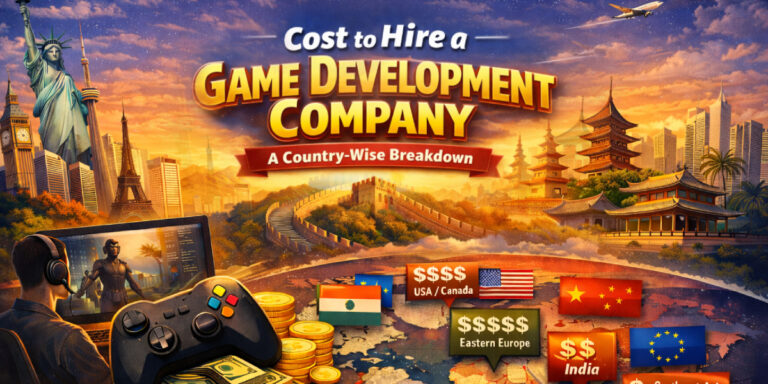
One of the first questions businesses ask when planning a game project is deceptively simple: How much does it cost to hire a game development company? The reality is that...
A full-cycle game development approach is not defined by how quickly a game is shipped or how many features it includes at launch. It is defined by how consistently the...

Choosing the right game development company is not just about creative output or technical expertise; it’s about understanding how a project moves through the end-to-end game development process, from early...
Select Files From Your Computer or Google Docs or Dropbox URLs


 Book An Appointment
 WhatsApp