


How to Monetize Your AR & VR Game in 2025?
- Home
- /
- Blog
- /
- Game Development
- /
- How to Monetize Your...
Our Services
How many times have you been part of a real-time, almost lifelike gaming experience, where you are present on the spot? Imagine the fun of playing a game that really takes you into a captivating virtual world that feels very physical. If you are already familiar with AR and VR, you know it’s very much possible. You may have experienced it, and that’s exactly why you want to know how your game can bring you money. AR VR game development services are exactly how you can monetize your game.
Augmented Reality (AR) and Virtual Reality (VR) technologies have been transforming gaming with their interactive elements. AR blends 3D graphics with the physical surroundings and creates a multidimensional space, while VR makes it possible to use physical activities through specific devices to make the experience immersive.
The global augmented reality (AR) gaming market is forecast to expand from USD 14.78 billion in 2025 to USD 88.66 billion by 2034, representing a compound annual growth rate (CAGR) of 22.2% over that period. On the other hand, according to Fortune Business Insights, the worldwide VR in gaming market was valued at USD 17.96 billion in 2023 and is projected to reach USD 22.63 billion by 2024, with a CAGR of 30.4% from 2024 to 2032.
AR and VR have matured into rich playgrounds for storytellers, explorers, and social connectors. As the headsets slim down and AR glasses edge closer to mainstream, monetization strategies must evolve beyond one-off purchases. Today’s players crave ever-fresh content, seamless service access, and immersive brand experiences. Here’s what revenue engines forward-thinking studios are using for AR/VR game monetization.
Core Monetization Strategies for AR & VR Games
As immersive experiences become the norm, studios must adopt multi-faceted revenue playbooks. Here are five foundational strategies, each illustrated with real-world successes, that will power AR/VR titles in 2025 and beyond.
1. In-App Purchases That Evolve with Player Journeys
The days of static cosmetic packs are behind us. In 2025, AR VR game development services are layering dynamic content drops in top titles. For example, character skins that adapt to real-world seasons or AR filters tied to local events. By using contextual triggers, such as a city’s festival, developers can unlock limited-edition items and charge a premium for authenticity. VR experiences, too, are pushing “modular DLC,” where players subscribe to narrative episodes or quest arcs, each seamlessly downloaded in the background.
Behind the scenes, data-driven catalogs automatically surface items most likely to resonate with each user, reducing clutter and boosting conversion. When a sci-fi VR shooter notices you favor plasma weapons, it will gently nudge you toward the next futuristic gear pack or weapon-skin bundle.
Examples:
- Seasonal Event Bundles: When detects the Lunar New Year in your region, it upsells cherry-blossom armor and themed AR filters, driving urgency and authenticity.
2. Subscription Models for Ongoing Engagement
Subscription services are no longer limited to AAA VR fitness or meditation apps. In AR gaming, monthly passes can grant VIP access to exclusive social hubs, geo-based challenges, or multiplayer arenas. By structuring content into seasonal “seasons” or “chapters,” studios maintain a predictable revenue stream while keeping players hooked on fresh experiences.
For example, an AR scavenger-hunt game might roll out a “Metro Season Pass,” granting entry to underground locations, collaborative Heist Missions with friends, and a rotating roster of virtual pets that learn your daily routines.
Examples:
- Monthly Season Passes: Monster Hunter Now’s Premium Season Pass delivers new monsters, quests, and avatar emotes every 30 days, keeping players invested and generating steady recurring revenue.
- Geo-Based VIP Access: CityScape AR’s CityPass grants entry to exclusive multiplayer arenas in real-world locations, from subway catwalks to rooftop concerts, lengthening sessions and deepening community bonds.
3. Seamless Advertising and Sponsored Content
Immersive ads in AR & VR must feel organic. In 2025, we’re seeing branded portals, miniature versions of real storefronts placed in virtual towns, where players can interact with a product demo, then buy the actual item for home delivery. VR racing leagues embed sponsor banners on trackside billboards that dynamically update based on viewer demographics. These placements become non-intrusive revenue sources, blending gaming and commerce.
Moreover, “Play-and-Earn” brand tie-ins let players earn real-world discounts by completing in-game challenges. Finish a coffee-brand obstacle course in AR, and you unlock a coupon for your next latte.
Examples:
- Virtual Storefronts: In VR racing leagues, banners from real-world sponsors (like Oracle or Heineken) update dynamically with targeted offers.
4. Strategic Partnerships and Collaborations
Collaborating with established brands or an experienced game app development company amplifies reach. Meta’s Horizon Worlds, for instance, regularly invites fashion houses to drop virtual apparel collections, turning digital wearables into coveted status items. Indie studios can partner with local businesses to create geo-tied scavenger hunts, increasing foot traffic while generating sponsorship fees.
On the VR side, cross-studio alliances allow asset sharing: a detective’s magnifying glass from one title becomes a usable tool in another mystery game, driving microtransactions across multiple experiences and encouraging cross-play loyalty.
Examples:
- Digital Couture Drops: Meta’s Horizon Worlds sells Prada and Balenciaga avatar skins for a few dollars each, tapping fashion hype to drive microtransactions.
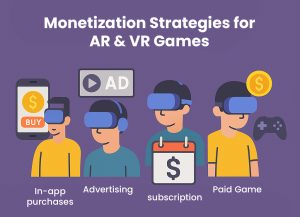
5. Emerging Frontiers: Tokenization and Virtual Real Estate
Blockchain-powered tokenization is reshaping ownership in AR & VR. Unique digital land parcels, storefronts, and collectibles can be traded on open markets. Developers can earn royalties on every secondary sale, creating an evergreen revenue stream. Imagine a player building an AR art gallery on virtual real estate; each piece they host could pay them a cut whenever someone visits or interacts.
Similarly, limited-edition non-fungible tokens (NFTs) can grant holders special privileges: early access to new quests, private multiplayer lobbies, or co-creation rights on future content.
Examples:
- Evergreen DLC via Land Sales: Decentraland offers secondary royalties for wearables or other collections (not LAND parcels). In January 2022, a DAO proposal enabled a 2.5% royalty on resale of user‑generated wearables, redirecting what used to go to the DAO to creators instead.
- NFT-Gated Content: Studios release limited NFT passes that grant holders early quest access or private social lobbies, and even as these NFTs trade on secondary markets, developers earn 2–5% on each sale.
By weaving together adaptive in-app purchases, subscription ecosystems, seamless sponsorships, and next-generation tokenization, an AR/VR game development company can craft monetization frameworks that respect player immersion and fuel long-term growth. In 2025’s AR & VR frontier, the most successful games won’t just sell content; they’ll build living worlds that evolve alongside their communities.
Key Strategies at a Glance:
- Dynamic, data-driven in-app purchases
- Season-based subscription passes
- Non-intrusive branded portals and challenges
- Cross-industry partnerships for co-branded experiences
- Blockchain-enabled ownership and royalties
Conclusion
Monetizing your AR and VR game will take expertise, a very in-depth knowledge of these industries, identifying future trends, and doing something that feels personal, driving revenue by offering appealing and satisfying gaming. Hire game developers specializing in extended reality (XR) for a deep dive into the world of AR and VR gaming and find out how you can make a game that delivers on both ends.
Reach out to Red Apple Technologies today for a free consultation on your dream project and find out how we can help make it a reality.
To Have A Better Understanding On This Let us Answer The Following Questions
Are subscription models viable for AR/VR games?
Answer: Yes. Subscription passes deliver fresh content and build habitual play:
- Monthly “Season Passes” with new quests, monsters, or multiplayer arenas.
- Geo-based VIP passes granting access to exclusive real-world locations and social hubs.
- Rotating rewards (virtual pets, avatar emotes) that tether to players’ daily lives and routines.
This approach locks in recurring revenue while fostering a community around evolving content.
How can I integrate advertising without breaking immersion?
Answer: Effective AR/VR ads blend into the environment:
- Create virtual storefronts where players explore branded demos and purchase real-world items.
- Use trackside billboards in VR racing that update dynamically with targeted offers.
- Introduce “play-and-earn” challenges; complete an in-game task to unlock a coffee coupon, for instance.
This non-intrusive model turns ad space into an extension of gameplay, not an interruption.
How should I choose the right monetization mix?
Answer:
- Define your game’s core loop and player motivation (exploration, competition, socializing).
- Align each revenue engine with that loop; cosmetics for self-expression, subscriptions for narrative, ads for world building.
- Prototype and A/B test pricing, drop frequency, and ad placement.
- Monitor KPIs: ARPU (average revenue per user), churn rate, conversion rate.
- Iterate based on data and community sentiment, ramping up what resonates and retiring what doesn’t.
A balanced portfolio of strategies spreads risk and maximizes lifetime value.
How can I measure and optimize monetization performance?
Answer:
- Track user segments, purchase funnels, and drop-off points.
- Use real-time analytics to surface best-selling items and underperformers.
- Conduct cohort analyses to see how different monetization paths affect retention and spend.
- Solicit qualitative feedback via in-app surveys and community channels.
- Continuously tweak offers, pricing, and delivery cadence to align with evolving player expectations.
A data-driven feedback loop ensures your AR/VR game remains both immersive and profitable.
When should I start implementing these monetization features?
Answer:
- Early concept phase: sketch tokenization and partnership roadmaps.
- Prototype stage: integrate basic in-app store and subscription logic.
- Closed beta: test pricing tiers, ad formats, and seasonal triggers with real users.
- Live launch: roll out core revenue streams, then layer in advanced features (blockchain, geo-VIP access) in post-launch updates.
Phased implementation lets you validate demand, refine UX, and manage development risk.
The Author
Related Blogs
Discover more stories & insights that inspire
A game aggregator is not just another software product. For investors, it is better understood as infrastructure: a platform that connects many game providers, delivers content through one system, and...
Despite occupying second position after China, the USA still manages to be a superpower in the global game industry. Whether game development or game publishing, the USA continues to shine...

Italy has quietly developed into one of Europe’s most creative mobile game development ecosystems. While the country may not match the scale of mobile gaming markets like the United States...
The United States continues to lead global immersive technology innovation. With strong hardware ecosystems, venture capital investment, and enterprise adoption accelerating across industries, AR VR game development in the USA...
Game development followed a familiar pattern for decades: build everything in-house or outsource isolated tasks when schedules slipped. That model has been quietly changing. It’s 2026, and while a section...

You’re reading this because 2026 isn’t just another year in gaming; it’s the tipping point where AI rewrites pipelines, cloud erases hardware barriers, and player creators become your most profitable...

With rising investments, game development has evolved into a profitable business alternative worldwide. Be it startups, agencies, Fortune 500 organizations, or angel investors, everyone is keen to join this creative...
Game development has evolved as the most flourishing industry worldwide. With a global market value of $300 billion, the gaming industry is rapidly capturing the attention of business owners with...
A full-cycle game development approach is not defined by how quickly a game is shipped or how many features it includes at launch. It is defined by how consistently the...
For decades, video games were seen as one-off entertainment products. A studio launched a title, players bought it once, and revenue ended there. But the industry has transformed into one...


 Book An Appointment
 WhatsApp