


Did you know: esports started in 1972 at Stanford University with the Spacewar! Tournament?
The global esports market size is expected to reach a value of over $5.9B with over 220M players. Esports (short for electronic sports) is everywhere today. Its popularity is growing rapidly and while top titles like DOTA 2, Counter-Strike, VALORANT, and League of Legends have been the global gaming community’s excitement, with major broadcasters like BBC, Sky Sports, and ESPN covering these tournaments, mobile esports witnessed a massive surge over the past few years.
Gaming was traditionally console- and PC-based, and, naturally, competitive gaming like esports was limited to them. But as smartphones and tablets made gaming accessible to nearly everyone, the esports scene transformed completely.
What Is Esports?
For those new to this genre, esports is probably the most trending and loved type of games out there. These are competitive video game tournaments that allow individuals or teams to compete for money and fame, just like traditional sports. The difference is that esports uses electronic systems, such as PCs, consoles, or mobile, involving players who showcase high levels of skill in strategy, coordination, and quick reflexes.
While the games are simply exciting, they are made even more desirable for both gamers and developers by streaming to large audiences, which creates a significant industry with substantial revenue and sponsorship opportunities.
Key Aspects of Esports
- Competition: Individuals or teams compete against each other in established video games.
- Organization: Competitions are structured through organized leagues, tournaments, and official governing bodies.
- Technology: Electronic systems, including PCs, consoles, and mobile devices, are used to play these games.
- Professionalism: More than casual players, esports gamers train hard and the top players even earn significant salaries, bonuses, and endorsements.
- Audience: Esports events attract a large number of spectators, both online through streaming platforms like Twitch and in person at large venues, similar to conventional sports.
- Community: Esports create a sense of community and belonging for players and fans, just like… you know what.
What Makes Mobile Esports Popular?
Now, we could talk about the world’s biggest esports titles that have kept all others who have tried to enter the market out of the market. Titles like League of Legends, Valorant, and CS:GO are on top of every competitive video game out there. So, the focus for many developers and studios shifted to the booming smartphone market. Over the past decade, esports managed to slip into our pockets and turned into our go-to pastime games or even the mode of earning for many. But how did mobile esports pull it off?
What Makes Mobile Esports Popular?
1. Accessibility: There are about 7.21 billion smartphones in the world. That’s nearly 90% of the global population. It means that irrespective of ages, skill levels, and backgrounds, mobile games can reach players. No matter where they are, if they have a mobile device, internet, and their favorite game, they are good to go.
2. Affordability: Consoles and PCs are expensive and beyond most people’s capacity. Mobile devices are more affordable (at least, most of them). Most esports games are free-to-play and include in-app purchases like cosmetics/skins that provide the game development company behind it a way to generate revenue without selling the game up-front. These mobile esports games like CODM and MLBB have brought competitive engagement to many players without a massive financial investment.
3. Portability: Even when portable gaming devices were invented, they weren’t pocketable. They were still bulky even though portable. But now, smartphones can be taken anywhere, giving players a shot at gaming sessions on the go, be it on the bus, at a cafe, or on the beach.
4. Versatility: Mobile esports can range from casual games where players thrill themselves on quick, short matches like Clash Royale or nail-biting competition like PUBG Mobile or Honor of Kings. Mobile game development services are able to deliver all kinds of games, from fast-paced to long-lasting experiences. Players of all skill levels can find an esports game they can’t put down.
There are various other reasons for mobile esports to become popular, including the involvement of celebrities across the world of music and sport, be it Drake or Michael Jordan. Real sporting teams are buying esports franchises!
Then there’s technology. With higher-bandwidth 5G networks, watching others play or playing a game ourselves, even without being on a wi-fi network, is appealing. Esports seems to be leaving behind the days of lag and latency.
Where Is Esports Popular?
1. Asia
Esports is at its best in Southeast Asia. MOBA titles like Mobile Legends: Bang Bang (MLBB), Honor of Kings (HOK), and Arena of Valor (AOV) have created dynamic esports landscapes. MLBB recorded a viewership of over 5 million concurrently for the game’s world championships in 2023.
The esports dominance within the SEA is the inclusion of official medal events for the 2022 Asian Games. Alongside global phenomena like DOTA 2, League of Legends, Street Fighter V, and FIFA were mobile games like AOV and PUBG Mobile, as medal-winning events.
PUBG Mobile has had ups and downs in India, including the ban of over 300 Chinese games and apps like Free Fire and TikTok. However, PUBG Mobile still has an impressive scene in other regions. The game’s Pro League Season 4 Indonesia recorded an average viewership of 239,852 in its 96-hour runtime.
Likewise, the Free Fire World Series 2021 Singapore became the world’s most viewed esports tournament with an audience of 5.4 million (excluding Chinese viewership). Over 1.9M viewers were Hindi, 1.3M Indonesian, 1.6M Portuguese, and 890,276 Spanish speakers.
2. Latin America
It is steadily becoming one of the biggest targets for esports gaming app development agencies. Free Fire is LATAM’s largest mobile esports game with massive popularity in Brazil. The Liga Brasileira de Free Fire (LBFF) partnered with financial services company Santander and launched a fantasy game.
With the LATAM scene growing, it has opened up opportunities for entrepreneurs and investors. TSM FTX (renowned for supporting League of Legends) had acquired a Brazilian Free Fire roster to compete in the LBFF.
While it is popular within Brazil, mobile esports is still evolving here. MLBB and League of Legends: Wild Rift are focusing on hosting big leagues here, and the scene seems to be expanding.
How Can Mobile Esports Generate Revenue?
As is the idea of this entire article, mobile esports is attracting significant attention from players, audiences, and sponsors. Whether it is local tournaments or global competition, esports is truly rising. So, how do investors take advantage?
Partnerships & Sponsorships
Mobile esports has become a profitable space for brands and sponsors. Mobile network providers or gaming hardware developers, everybody is trying to tap into the remarkable, loyal esports audience as increasing viewership grows the opportunity for generating revenue. Brand partnerships are also assisting in expanding the reach of these events to more people.
Streaming Platforms
It would be disgraceful if we did not bring up big names like Twitch, Discord, YouTube, and Facebook Gaming, which have been integral to popularizing esports. Anyone can tune in to live streams wherever they are, watch highlight reels, and much more in real-time. This accessibility means that fans can follow the matches, think of strategies, and engage with their favorite players without having to go anywhere.
Regional and Global Competitions
Esports is not simply fun gaming—professional gamers take the games very seriously, especially when their prizes come in millions of dollars. The competition is intense, and the rewards are worth fighting for every game. Popular esports tournaments are coming at par with PC/console counterparts in terms of viewership and value.
Create a Mobile Esports Game
Hire esports game developers to make your very own multiplayer online battle arena game and roll it out to the market. Like most, you can keep it free-to-play but include in-game monetization models like optional cosmetics, subscriptions, and passes to generate revenue. It is one of the most preferred and convenient ways to make money out of your game. There are brand partnerships, sponsors, and so much more to add to it.
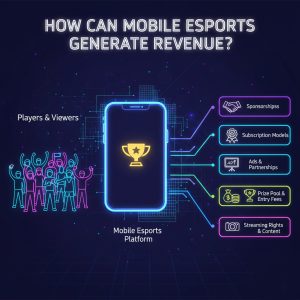
Is Investing in Advertisements in Mobile Esports Games Profitable?
Esports tournaments draw huge audiences into the arenas. Even when a tournament is broadcast, there are millions watching it. In 2019, the Free Fire World Cup was held in Bangkok, which was attended by more than 15,000 esports fans, which means there is a big opportunity for branding at the venues.
If you are an advertiser who wants to put on non-intrusive ads to engage the audience, you have that too. The racing game Asphalt 9 has branded in-game screens, branded car skins, sponsored vouchers, and advertising opportunities on the virtual billboards in the environment.
What’s the Future of Mobile Esports Like?
The world of esports gaming app development seems to be booming, as the player base continues to grow. The future seems to be brighter than it already is. Technology is improving, and so is the potential for pushing the boundaries of mobile games, be it in terms of gameplay, graphics, or the addition of further competitive features. Here’s what esports games are very close to achieving; in fact, some already have:
- Cross-Platform Play: It is likely going to be more common in the coming years. The same game can be played on mobiles, consoles, and PCs. While PC and console users may have the upper hand, continuous technological advancements are set to put mobile gamers on par with the big boys.
- Augmented Reality and Virtual Reality Integration: Mobile hardware has come a long way in just two decades, offering powerful advancements. As AR and VR technologies continue to gain popularity, they may soon be a reality in esports.
- Mainstream Popularity: Mobile esports has seen massive popularity in just a few years. The tournaments are becoming more organized, the prize pools are getting bigger, and the fanbase is just astounding. There already are players dedicated to specific esports titles. Someday soon, esports may be a full-time career option for many.
[optin-monster slug=”e451xbj0coom26uqd50h” followrules=”true”]
How We Help
We have told you everything you need to know about mobile esports. We have always been in sync with what’s happening and ahead of others when it comes to aligning businesses with the trend. We foresaw the potential of mobile esports gaming, and we haven’t been wrong.
Red Apple Technologies is a full-cycle game and app development company that blends cutting-edge tech with deep industry expertise to deliver scalable, monetizable, and player-centric esports experiences. Their approach covers concept-to-live-ops, ensuring that every stakeholder—from indie developers to global publishers—can launch and grow competitive gaming products with confidence.
We Serve All Stakeholders in Esports
1. For Developers: Building & Scaling Competitive Games
- Full-Cycle Development: From game design documents (GDDs) to final deployment, they handle esports titles across Unity, Unreal, HTML5, and custom engines.
- Cross-Platform Support: Mobile, PC, console, and cloud gaming integration for maximum reach.
- LiveOps & Event Systems: Built-in tournament modes, leaderboards, matchmaking, and seasonal events to keep player engagement high.
- AI & Analytics Integration: Real-time performance tracking, player behavior analysis, and balancing tools for competitive fairness.
2. For Publishers: Monetization & Market Research
- Integrated Monetization Frameworks: In-game ads, battle passes, skins, and microtransactions optimized for esports audiences.
- Localization & Cultural Adaptation: Ensuring games resonate with global esports markets.
- Scalable Infrastructure: Cloud-based backend with 99.99% uptime for uninterrupted tournaments and live events.
- Brand Partnerships: Tools to integrate sponsor branding seamlessly into esports broadcasts and in-game environments.
3. For Studios: Expanding Production Capabilities
- On-Demand Talent: Access to 2D/3D artists, animators, UI/UX designers, and esports-specific gameplay engineers.
- White-Label Solutions: Studios can launch esports platforms under their own brand without building from scratch.
- Blockchain & Web3 Readiness: NFT-based rewards, tokenized economics, and secure digital ownership for esports ecosystems.
- AR/VR Esports Experiences: Immersive competitive formats for next-gen audiences.
4. For Investors: De-risking and Maximizing ROI
- Rapid MVP Development: 90-day prototypes to validate esports concepts before full-scale investment.
- Data-Driven Forecasting: Market analysis, player acquisition cost modeling, and revenue projections.
- Portfolio Diversification: Opportunities in mobile esports, VR arenas, and Web3-enabled competitive platforms.
- Security & Compliance: Enterprise-grade protection for transactions, player data, and intellectual property.
5. Why Red Apple Stands Out in Esports Development
- 14+ Years of Industry Experience with 500+ global brand collaborations.
- Proven Esports Projects like VRArena Combat, a multiplayer VR battle arena with real-time motion combat.
- Tech Stack Mastery: AI, blockchain, AR/VR, cloud gaming, and scalable backend systems.
- End-to-End Support: From product discovery to post-launch optimization.
Conclusion
From the first esports competition held back in a University to today’s multi-million-dollar leagues, esports is one of the most dominating fields in the gaming industry. Mobile gaming is on the rise, and competitive multiplayer games are being rapidly integrated into the world of esports. They have transcended the realm of casual games played just for fun. Today, there are a lot of competitive titles that allow players to play alongside friends against others and bring home mega wins.
Advertisers and sponsors are investing in these games, entrepreneurs are availing mobile game development services to create new esports titles for profit, and the progress doesn’t seem to slow down one bit. With the mobile gaming revolution, we are witnessing the birth of a new world of competitive gaming.
If you want to take advantage of the raw potential of esports, hire a dedicated team from Red Apple Technologies for your very own esports gaming app development and step into the other side of mobile gaming with over 14 years of experience and over 150 professionals on our end.
To Have A Better Understanding On This Let us Answer The Following Questions
What is the scale of the mobile esports market, and how much game time do players invest?
Answer: According to Newzoo, the mobile gaming market is projected to generate $136.9 billion, with users spending 30% more time in gaming apps than in social media apps.
How large and competitive is the mobile esports ecosystem?
Answer: As of 2023, there were around 929 major mobile esports tournaments, with prize pools exceeding $2 million. Over 857 professional mobile esports teams are active globally, and top players can earn hundreds of thousands in salaries and endorsements.
What are the primary revenue streams for mobile esports?
Answer: Mobile esports monetizes through:
- Sponsorships: Sponsored teams, events, and in-game branding—especially in booming regions like Southeast Asia and Latin America. Market Research Intellect.
- In-Game Advertising: Banners, interactive placements, and ads embedded in live streams or events. Market Research Intellect.
- Subscriptions & PPV Models: Fans pay for premium access to exclusive content, behind-the-scenes footage, or tournament coverage
What challenges does mobile esports face?
Answer:
- Hardware Fragmentation: Diverse device specs make maintaining fair competition difficult. CP Gaming.
- Cheating & Security: Mobile platforms are more exposed to exploits, requiring stronger anti-cheat systems, CP Gaming.
- Regulatory Concerns: Issues like data privacy, fair monetization, and gambling need better regulation
Are there moves toward more professional structures in mobile esports?
Answer: Yes, there’s increasing professionalization with structured leagues, player contracts, and development of franchise-based models, collegiate programs, and formal governance systems.

Build an Open Finance Platform
Related Blogs
Discover more stories & insights that inspire
Esports has evolved from a niche hobby into a global entertainment powerhouse, attracting millions of viewers and generating billions in revenue. While traditional revenue streams like sponsorships, broadcasting rights, and...
The recently passed Promotion and Regulation of Online Gaming Bill 2025 has imposed a strict ban on real-money games and online gambling platforms across India. It has put an end...
Esports development is a normal term coined for describing video game competitions. Compared to other sporting events, games belonging to esports genre are majorly played in from of live spectators...


 Book An Appointment
 WhatsApp