


- Blog
- >
- Game Development
- >
- Battle Passes and In-App...
Battle Passes and In-App Purchases: The Future of Game Monetization for Investors
For decades, video games were seen as one-off entertainment products. A studio launched a title, players bought it once, and revenue ended there. But the industry has transformed into one of the most resilient and recurring-revenue businesses in the global entertainment sector. Today, game monetization strategies like battle passes and in-app purchases (IAPs) are the backbone of modern gaming, shaping long-term player engagement and predictable revenue streams.
For investors, understanding how these models work — and how studios execute them — is crucial. They represent not just a trend, but a structural shift in the way games generate value. With billions of players worldwide and increasingly sophisticated live-service models, the opportunity is significant, provided investors know what to look for.
Why Game Monetization Matters
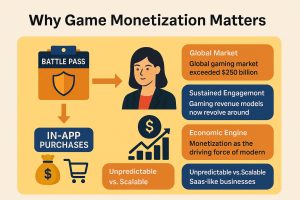
The global gaming market exceeded $250 billion in 2024, and much of that growth stems from recurring business models. Unlike traditional boxed sales, gaming revenue models now revolve around sustained player engagement. Battle passes and IAPs are central to this, converting active users into repeat spenders over months and years.
Investors should see monetization not as an afterthought, but as the economic engine of modern games. Done well, it turns unpredictable hit-driven projects into scalable SaaS-like businesses. Done poorly, it can alienate players and shorten a title’s lifespan.
The Rise of Battle Passes
A battle pass is a seasonal, time-limited progression system offering two tiers: a free track with basic rewards and a paid premium track with exclusive content. The idea is simple but powerful — players pay a modest fee (often $5–15 per season) for access to premium progression, with rewards unlocked by completing gameplay challenges.
Why It Works for Studios and Investors
- Recurring Revenue Pulse: Each season creates a fresh opportunity for monetization. Instead of relying on new titles, studios generate ongoing income from the same player base.
- Engagement Engine: Battle passes drive daily logins, weekly missions, and long-term retention — metrics that directly correlate with higher lifetime value (LTV).
- Predictability: With established user bases, conversion rates can be forecast season after season, creating stable revenue models attractive to investors.
- Transparency: Unlike loot boxes, battle passes are clear about what players will receive. This reduces regulatory risks and consumer backlash.
In-App Purchases: The Backbone of Gaming Revenue Models
While battle passes provide structure, IAPs are the everyday monetization tool. These include cosmetic skins, in-game currency, consumables, boosters, and even subscriptions. IAPs turn free-to-play games into billion-dollar franchises.
Why IAPs Matter for Investors
- Scalability: Even small percentages of paying users can create massive revenue at scale.
- Flexibility: Games can test, adapt, and localize offerings, tailoring IAPs to regional preferences.
- Whale Economics: A fraction of high-spending users (“whales”) can disproportionately boost revenue, while smaller spenders provide broad base stability.
- Hybrid Strategies: IAPs and battle passes work together — passes bring players in, while IAPs capture extra spend from engaged users.
Key Investor Metrics to Track
Before allocating capital, investors should focus on the following KPIs:
- Conversion Rate (Battle Pass): % of active users buying the premium pass.
- Repeat Purchase Rate: The percentage of players buying the pass season after season.
- ARPPU & LTV: Average revenue per paying user, and the long-term value of pass purchasers vs. non-purchasers.
- Retention Curves (D1, D7, D30): Strong engagement means stronger monetization.
- UA Payback Period: How quickly acquisition costs are recovered from monetization.
- Attach Rate: How often pass buyers also spend on IAPs or premium bundles.
Investors should demand dashboards or audited reports, not just slides, to validate these numbers.
Risks to Watch
Like any revenue model, battle passes and IAPs carry risks.
- Player Fatigue: Poorly designed passes feel like a grind, leading to churn.
- Pay-to-Win Backlash: Monetization that creates unfair advantages drives negative sentiment.
- Over-Reliance: If more than 70% of revenue comes from one monetization stream, the studio is vulnerable to market shifts.
- Regulation: Certain regions may clamp down on manipulative practices. Transparency is key.
The Investor’s Playbook
So how can investors capture returns from these monetization models?
1. Back Studios with Proven Live-Ops Teams
Success depends on execution. Teams with experience running seasonal content and optimizing passes are lower-risk bets.
2. Look for Strong Analytics Infrastructure
Without data-driven decision-making, studios cannot optimize conversion or retention.
3. Diversify Across Titles and Segments
Combine mobile free-to-play, PC/console live services, and XR experiments for balanced exposure.
4. Demand Transparency in Cohorts
Evaluate metrics like DAU/MAU, LTV:CAC, and churn across geographies. Numbers > narratives.
5. Prefer Ethical, Transparent Monetization
Studios that avoid exploitative mechanics have stronger long-term brand equity.
Why Mobile Remains the Growth Driver
Mobile continues to dominate in scale, reach, and revenue potential. With billions of smartphones worldwide, mobile game development services are powering the majority of battle pass and IAP-driven titles. For investors, mobile studios with solid user acquisition strategies and live-ops experience are often the highest-upside bets.
What makes mobile so attractive?
- Lower friction for downloads and purchases.
- Broad global penetration, including in emerging markets.
- Free-to-play adoption with proven monetization.
- Cross-promotion opportunities across titles.
Studios offering these services also tend to operate more agilely, iterating faster on monetization models compared to large console-focused publishers.
How Red Apple Technologies Helps Investors
Investors don’t just need strong ideas — they need execution, and Red Apple Technologies provides a bridge. As a leading development partner, we help studios and investors bring monetization strategies to life. Our strengths include:
- End-to-End Development: From ideation to live ops, with monetization baked in from day one.
- Custom Economy Design: Balancing battle passes, IAPs, and subscriptions to optimize engagement and revenue.
- Analytics & Optimization: Continuous monitoring of KPIs to refine performance.
- Flexible Teams: Investors can directly hire game development team members from us, ensuring projects hit milestones without talent shortages.
- Cross-Platform Delivery: Expertise across mobile, PC, console, and XR expands the addressable market for every title.
Gain not just a development studio but a strategic ally in building sustainable, monetization-focused games.
Conclusion
Battle passes and IAPs have redefined gaming economics. They turn entertainment into a recurring-revenue business with predictable cashflows, higher LTVs, and scalable growth. For investors, this means exposure to one of the most durable and fast-growing revenue engines in the digital economy.
By focusing on key KPIs, mitigating risks, and partnering with capable development partners, investors can confidently participate in the next wave of gaming growth.
Now is the time to pay attention — because the future of game monetization is already here, and it’s driving the most compelling gaming revenue models the industry has ever seen.
To Have A Better Understanding On This Let us Answer The Following Questions
Answer: Battle passes and IAPs don’t perform equally across markets. For example, cosmetic skins dominate in Western markets, while progression boosters or gacha-style systems perform better in Asia. Investors should evaluate whether a studio has localized strategies that fit cultural preferences and regulatory environments.
Answer: Studios with strong monetization systems attract acquirers like publishers, tech giants, and even entertainment conglomerates. In addition to M&A, revenue-rich studios can pursue IPOs or licensing deals that extend their IP into film, TV, and merchandise. For investors, this means multiple liquidity options.
Answer: While highly profitable today, sustainability depends on balance. Overuse of grindy battle passes or aggressive IAP tactics can lead to player fatigue. Investors should prioritize studios that innovate their monetization systems with fairness, transparency, and fresh content updates.
Answer: Modern studios rely on AI-driven analytics to personalize IAP offerings, predict churn, and adjust pricing strategies dynamically. Investors should look for companies with strong analytics pipelines since data-driven monetization often outperforms intuition-based design.
Answer: Emerging models include subscriptions (like Xbox Game Pass), ad-based monetization, user-generated content (UGC) marketplaces, and blockchain-based digital asset sales. Investors who back studios experimenting with hybrid approaches gain exposure to future-ready revenue models beyond the current mainstream.
Our Services
The Author
Related Blogs
Discover more stories & insights that inspire
A game can have a strong core loop and still run into trouble if two business decisions are left until the end: how it will make money and how it...

An AR prototype built around one core interaction and a multiplayer VR game designed for several headsets should not receive anything close to the same estimate. Both may fall under...

A good-looking game can still fail to hold a player’s attention if its mechanics are unclear, progression feels unrewarding, or levels become frustrating for the wrong reasons. Game design goes...

Despite occupying second position after China, the USA still manages to be a superpower in the global game industry. Whether game development or game publishing, the USA continues to shine...

Italy has quietly developed into one of Europe’s most creative mobile game development ecosystems. While the country may not match the scale of mobile gaming markets like the United States...

The UAE — particularly Dubai and Abu Dhabi — has rapidly evolved into one of the Middle East’s most ambitious gaming hubs. Backed by government-led initiatives, global investment, and major...

Turkey has become one of the fastest-growing mobile gaming ecosystems in Europe. Over the past decade, mobile game developers in Turkey have produced globally successful casual and hyper-casual titles, attracted...

Spain has established itself as one of Europe’s most active mobile game development markets. With internationally successful studios, experienced live-operations teams, and competitive production structures, the country continues to attract...
Game development followed a familiar pattern for decades: build everything in-house or outsource isolated tasks when schedules slipped. That model has been quietly changing. It’s 2026, and while a section...

At some point, most gamers have said, just a few more minutes, only to discover that hours have passed without noticing. That isn’t a mere distraction; it’s a reflection of...


 Book An Appointment
 WhatsApp