


AR in Retail: Virtual Try-Before-You-Buy
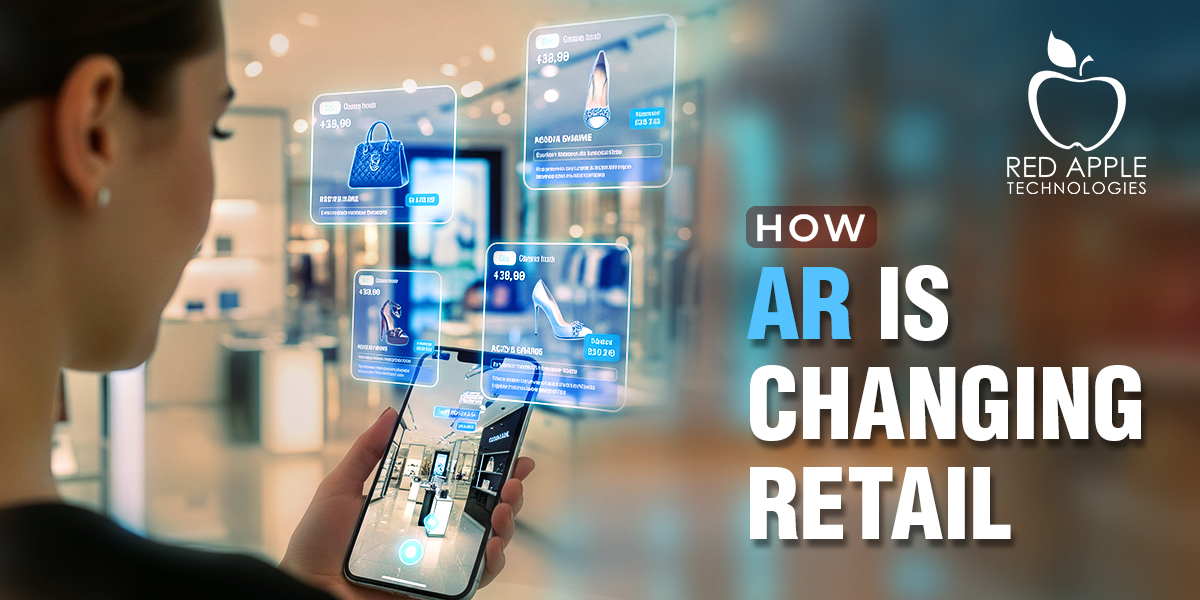
When we were watching television ads about new products, going to the store for shopping, or even when technological advancement sprouted e-commerce where we could buy products online, we didn’t realize how rapidly we were moving with innovation. Then, suddenly, we hear about this new technology that would forever change how we shop – Augmented Reality (AR).
Now, to be clear, the concept of augmented reality has been around since the 1960s, but it took decades before it could be advanced enough for general use. Today, it has come as far as to let us visualize what a product might look like on our floor, walls, or even on our bodies with virtual try-on solutions.
The Era of Shopping that Learns from You
Augmented Reality moved from a lab curiosity into a practical retail tool because it answered a simple human need: to see and understand products before committing money. In a world where the buyer’s confidence is everything, AR lets shoppers inspect size, fit, texture, and style in the context that matters—their own home, on their own face, or against their own living room wall. That’s why “virtual try-before-you-buy” isn’t just a marketing slogan; it’s a consumer expectation.
What Virtual Try-on Actually Does for Shoppers and Retailers
Virtual try-on implementations let customers experiment without friction. Want to see how a pair of sunglasses looks on you in sunlight? Hold your phone up and try them on. Curious whether a sofa will fit your living room and match your curtains? AR can overlay a photorealistic 3D model into your space so you can walk around it and inspect it from every angle.
For retailers, this reduces returns and increases conversion. Customers who can see a product in context are more likely to buy and less likely to be disappointed. It also opens new marketing channels through AR retail app development: sharable AR experiences that turn customers into content creators, user-generated social posts, and data-driven personalization based on which virtual items customers tried most.
Types of AR Experiences in Retail
There are a few common AR patterns that brands use:
- Markerless Room Visualization: Place furniture, rugs, or decor into a live camera view of a room.
- Face and Body Try-on: Virtually apply make-up, eyewear, jewelry, or clothing to a live image of the customer.
- Product Demos: Show animated or exploded views of products so shoppers can see how something works.
- Interactive Packaging: Scan a package to reveal tutorials, sustainability info, or coupons.
- In-Store Navigation Overlays: Indoor wayfinding that points shoppers to products, deals, or personalized picks.
All of these rely on a blend of accurate 3D models, robust tracking, and seamless UI, and that’s where development quality matters.
Building AR Experiences: What Goes into a Successful Project
Creating an experience that feels magical rather than gimmicky requires attention to detail:
- Accurate 3D Models and Lighting: Poorly modeled or badly lit virtual items break immersion. Photogrammetry, PBR materials, and environment reflections matter.
- Reliable Tracking and Occlusion: AR must understand surfaces, distances, and when virtual objects should be hidden behind real ones.
- Fast Performance: AR must run smoothly on the target devices; lag destroys trust.
- Intuitive UX: Simple onboarding, obvious controls, and clear calls-to-action turn curiosity into purchases.
- Data and Analytics: Track try-on engagement, conversions, and where users drop off to iterate quickly.
- Integration with Commerce Systems: Linking AR interactions to inventory, pricing, and checkout ensures the experience drives revenue.
If you’re planning this, consider partnering with teams experienced in AR retail app development who can combine design, 3D content, and engineering into something customers love.
Business Impact and KPIs to Measure
Retailers implementing AR often track:
- Conversion uplift (visitors → buyers)
- Return rate reduction
- Average order value (AOV) changes
- Time on product pages and try-on frequency
- Social shares and earned media
- Customer NPS or satisfaction related to the shopping experience
Measuring these lets you show ROI and prioritize which product lines or categories to expand AR for next.
Implementation pathways: from pilot to scale
Start small with a pilot: choose a high-margin or high-return-item category where visualization clearly adds value (sunglasses, shoes, furniture, makeup). Use that pilot to validate technical choices, test user flows, and prove revenue impact.
Then scale by:
- Improving 3D asset pipelines
- Adding more SKUs to the AR catalog
- Integrating personalization and recommendations
- Automating content generation where possible
A staged approach reduces risk and gives marketing teams time to craft campaigns around the new capability.
Real-World Features Customers Expect
Today’s shoppers expect more than “stick a model in the room.” They want virtual try-on solutions:
- Realistic lighting and shadowing
- Accurate size/scale representation with measurement tools
- Easy sharing to social or messaging apps
- Persistent try-on history and wishlist integration
- Accessibility options (captions, voice guidance, simple gestures)
Delivering these features shows maturity and makes the AR experience feel like a natural part of the brand.
Examples of the Tech You Might Use
While the specifics vary by platform, common building blocks include AR SDKs for tracking and scene understanding, WebAR for instant experiences, and native AR frameworks for deeper performance. Combining these with a solid backend for content and analytics creates a production-ready solution. That’s why experienced partners in AR app developers are valuable: they know which combination of technologies will hit the performance and scale targets your business needs.
Why Design + Engineering Matters More than the Buzz
Too many projects start with “let’s do AR” and end with a fragile demo. The difference between novelty and value is discipline: good design that respects real customer needs and engineering that focuses on reliability, low latency, and maintainable pipelines. Hire teams who treat 3D assets, UX, and commerce integration as equally important.
If you want to show stakeholders a range of completed work before you commit, ask to see an AR retail project portfolio. Reviewing real case studies and metrics will help you separate vendors who can prototype from those who can deliver production systems.
How Red Apple Technologies Can Help
Red Apple Technologies specializes in end-to-end AR solutions for retail. From initial strategy and proof-of-concept to large-scale rollout, their services include 3D asset creation, integration with e-commerce platforms, and experience design tailored to buyer behavior. If you need to hire AR developers who understand retail constraints, Red Apple Technologies can staff your project with engineers experienced in cross-platform AR SDKs, performance tuning, and backend integrations. They also offer options to hire voice app developers when you want to fuse voice assistants with AR; imagine voice-guided product discovery inside an AR showroom.
Key offerings:
- Strategy and product definition aligned with revenue goals
- Rapid prototyping and pilot deployment
- Scalable content pipelines for 3D assets
- Full-stack AR retail app development and post-launch analytics
- Staff augmentation: designers, 3D artists, AR engineers, and voice-app specialists
Working with a partner that can both design delightful experiences and handle the technical plumbing reduces risk and accelerates time to measurable results.
Roadmap Checklist for Retailers
- Choose a pilot category (high margin, high return reduction potential).
- Define success metrics (conversion uplift, return rate, AOV).
- Produce or procure accurate 3D content.
- Build a minimum viable AR experience and test on real users.
- Integrate with commerce and analytics.
- Iterate on UX and scale by adding SKUs and features.
If you don’t have internal AR expertise, consider partnering with an experienced AR retail app development firm to move faster and avoid common pitfalls.
Final Thoughts
Augmented Reality is no longer an experiment; it’s a strategic tool that lifts buyer confidence, reduces returns, and creates new marketing and personalization channels. When executed with proper design discipline and engineering rigor, virtual try-before-you-buy becomes a competitive advantage rather than just a gimmick. If you’re serious about bringing AR to your customers, look for partners who combine creative vision with solid production experience and who can show you measurable outcomes in an AR retail project portfolio.
To Have A Better Understanding On This Let us Answer The Following Questions
How much does an average AR pilot cost for a mid-size retailer?
Answer: When launching an AR pilot, costs vary widely depending on the type of experience and level of polish. Here’s an estimated price range:
- Simple marker-based pilot (basic overlays triggered by printed codes or logos): $5,000 – $15,000
- Medium-complexity pilot (object recognition, basic interactivity): $20,000 – $100,000
- Advanced markerless pilot (real-time SLAM mapping, high-quality 3D animations): $50,000 – $250,000+
A mid-size retailer aiming for a robust, customer-facing AR try-on or product visualizer typically budgets in the $20K–$75K range, factoring in 3D asset creation, development hours, and QA.
Which devices or minimum device specs should we support for the best AR experience?
Answer: To ensure broad coverage and reliable performance, target devices certified by major AR platforms:
- Android (ARCore-certified)
• Android 7.0 or later with Google Play Services for AR
• OpenGL ES 3.0+ support
• 4 GB+ RAM, modern multi-core CPU
• High-quality rear camera, accurate gyroscope/accelerometer for motion tracking - iOS (ARKit-compatible)
• iOS 11 or later on devices with Apple A9 chip or newer
• iPhone 6s/SE (1st gen) and later, iPad (2017+) and all iPad Pro/Air models
• 2 GB+ RAM, Metal-capable GPU for real-time rendering
For cutting-edge features like Depth API, ensure roughly 8 GB RAM and support for OpenGL ES 3.1+/Metal, which covers most flagship phones released in the past two years.
How long does it take to create photorealistic 3D assets for a 100-SKU catalog?
Answer: Photorealistic 3D asset creation is the most time-intensive phase, involving:
- High-precision modeling
- Detailed UV unwrapping and texturing
- Physically based material setup
- Lighting, rendering, and post-processing
- QA and iterative refinements
Industry averages put the effort at 8–24 hours per SKU, depending on product complexity.
- For 100 SKUs, that translates to:
• 800–2,400 total artist hours
• ~4–8 months of work for one modeler
• ~4–8 weeks with a dedicated team of 4–6 artists
Using a hybrid approach, combining photogrammetry scans, AI-assisted base meshes, and manual refinement, can shave 20–30% off these timelines.
What privacy concerns should be considered when collecting try-on analytics and camera data?
Answer: When capturing camera feeds and interaction metrics, retailers must guard against:
- Unauthorized biometric collection (facial scans, gait analysis) that can infringe on personal privacy
- Data retention risks if raw images or video streams are stored unencrypted on servers
- Third-party sharing of sensitive data with advertisers or analytics vendors
- Regulatory compliance under GDPR, CCPA, and other data-protection laws requiring explicit user consent
Best practices include:
- On-device processing with no server-side image storage, so data vanishes when the session ends
- Ephemeral analytics that log only anonymized metrics (e.g., time spent trying on a style, button taps)
- No facial recognition, limiting overlays to general key-point tracking rather than identity linkage
Strong encryption for any transit or minimal retention of analytics data, with clear opt-in disclosures and easy opt-out mechanisms
Can AR experiences be made accessible to users with visual or motor impairments, and how?
Answer: Absolutely. Accessible AR extends inclusivity and expands your audience. Key strategies:
- Alternative formats
• Audio descriptions or haptic feedback for visually impaired users
• Text magnification and high-contrast overlays on UI elements - Multiple input methods
• Voice commands, head gestures, or simple tap/swipe controls in lieu of complex multi-touch gestures
• Customizable gesture sets for users with limited dexterity - Spatial audio cues
• 3D-positional sound guiding users toward points of interest or actions - Assistive navigation
• Wheelchair-friendly pathfinding and obstacle avoidance in location-based AR scenarios
• Clear visual or audio waypoints for wayfinding in large spaces - Standards and testing
• Follow AR-specific accessibility recommendations and engage users with disabilities in usability testing to uncover barriers early
By integrating these features coupled with iterative user feedback, you can deliver AR that’s truly accessible to everyone.
Get Started
- End-to-End Game & App Development Services
- Flexible Business Models – Project Based or Dedicated Hiring
- 13+ Years of Industry Experience with Global Clientele
- Globally Recognized by Clutch, GoodFirms & DesignRush
Related Blogs
Discover more stories & insights that inspire

Usually, you have to type your queries manually when using any mobile app. But with the introduction of the voice search feature, you can easily place your query orally to...

Gamification in ecommerce is becoming a popular strategy to engage customers, improve retention, and increase sales. By incorporating game-like elements into the online shopping experience, businesses can create more interactive...
Possibilities in the ecommerce market are steadily increasing with rapid digitization and the surge in technology-proficient users. At present, the global revenue generation from the ecommerce industry has reached a...

Exhibiting a robust market value of $5.8 trillion, the market of e-commerce/retail is steadily growing with rapid digitization. With rising possibilities and competition in the e-commerce/retail segment, engaging and retaining...
At present, the e-commerce industry is emerging as the biggest source of global revenue. Flaunting a robust market size of $4,173.00 billion, prospects in the e-commerce sector are steadily increasing...
Augmented Reality (AR) made its first full-fledged impact with the arrival of the Pokemon Go game in 2016 where users have to compete with the pokemons in a realistic setting....
Ever since Augmented Reality (AR) made its entry with the Pokemon Go game in 2016, industry experts are very much impressed with the performance of this cutting-edge technology. They are...
As per the market reports by Statista, by 2025, the size of the AR market is expected to reach 1848.9 million dollars. To know more about its real time implications...

Augmented reality has taken its foundation with its first use case by the US Air force in the year 1992 and since then it has set a mark in its...

These days both Augmented Reality and Virtual Reality as a technology has become popular among businesses and professionals. These two are reigning trends in the industry of mobile app and...


 Book An Appointment
 WhatsApp